

A Voyage Along the Great Lakes - with Smithsonian Journeys
Cruise Line: Ponant Cruise
Ship: Le-Bellot
Sailing Date: Aug 13 2027
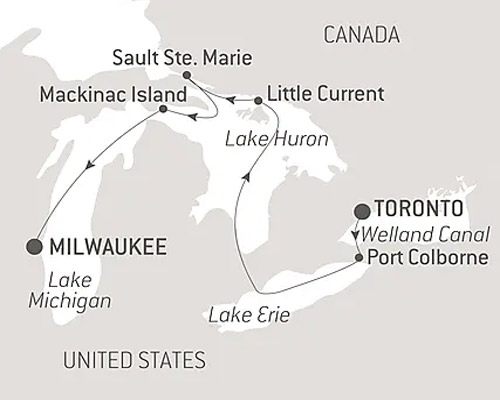
Route: Toronto - Milwaukee
Duration: 8 Nights
A Voyage Along the Great Lakes - with Smithsonian Journeys
Ports of Call & Excursions
Day 1 - Toronto
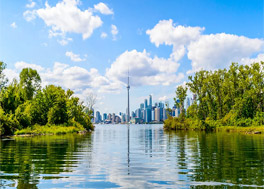
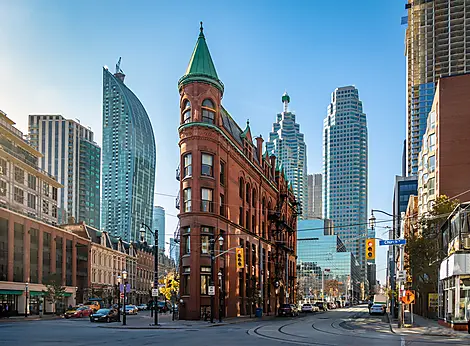
The largest city in Canada and capital of the province of Ontario, Toronto fascinates as much by its incredible diversity as by its size. Make sure you visit the CN Tower, the tallest tower in the western hemisphere, as well as the St. Lawrence Market whose stalls reflect the multicultural wealth of this city known as the global city. Not far from there, the historic Distillery District unveils its brick-paved streets imbued with romantic charm and its myriad of small restaurants, cafés, boutiques, theatres and art galleries. The Royal Ontario Museum and its impressive collections devoted to the worldâs natural and cultural history will also be an unmissable stop during this port of call.
Day 2 - Going through the Welland Canal locks
Day 3 - Port Colborne
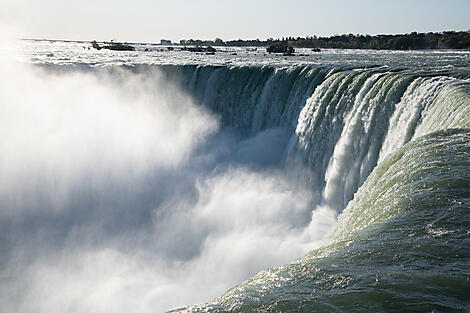
Port Colborne is a small port city located in southern Ontario, at the mouth of the Welland Canal. It is well-known for one of the longest locks in the world: measuring 420Â metres, this lock, the 8th in the canal, has an observation footbridge and marks the final transit point before the Erie Canal. In addition to the discovery of this tremendous hydraulic infrastructure, this port of call will be your privileged access point to the famous Niagara Falls, renowned all over the world for their spectacular beauty. Located on the river of the same name, which means âwater thunderâ in Amerindian language, these wonders of nature are among the most powerful waterfalls in the world.
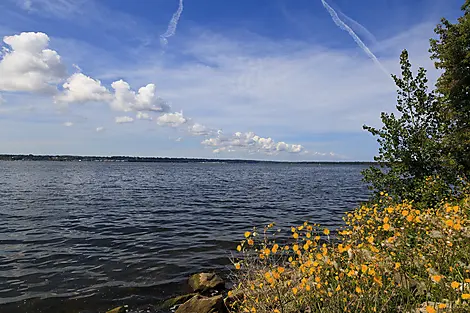
Day 3 - Sailing Lake Erie
Located to the south of Lake Huron and connected to Lake Ontario by the Welland Canal, Lake Erie, which owes its name to one of the Amerindian tribes which peopled its banks before the arrival of the French in the 17th century, is remarkable for its unique ecosystem. Its shallow fish-filled waters make it an excellent fishing spot, while its banks, famous for their many migratory birds, attract photographers and ornithology enthusiasts.

Day 4 - Sailing through Detroit
During your navigation along the Detroit River, an important commercial waterway linking Lake Erie and Lake St. Clair to Lake Huron, you will sail along the largest city in Michigan. Youâll then enjoy panoramic views over the skyscrapers of the former Motor City, jewel of the automotive industry, Fordism and Motown music in the 20th century. Youâll also be able to admire the Ambassador Bridge, which spans the river and enables access to Windsor, on the Canadian shore of the river. This steel suspension bridge, over two kilometres long, was constructed in 1929. This bridge alone carries over 25% of trade between the United States and Canada.

Day 5 - Sailing Lake Huron
A natural border between the American State of Michigan and the Canadian province of Ontario, Lake Huron is one of the five American Great Lakes and one of the largest freshwater lakes in the world. Comprising the main lake, Saginaw Bay, the North Channel and Georgian Bay, and home to around 30,000Â islands, it offers varied coastal landscapes and unique views. From your ship, youâll thus be able to admire the wild beauty of the wooded and at times craggy coastline of Manitoulin Island, or the spectacular cliffs of the Bruce Peninsular.
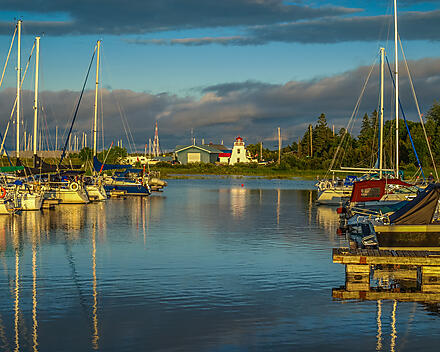
Day 5 - Little Current
A small port town located along the North Channel of Lake Huron, Little Current is considered to be the gateway to Manitoulin Island, the largest freshwater island in the world. The townâs emblematic construction, the Little Current Swing Bridge built in 1913, provides the only land access to the island, peaceful lands whose name means âthe island of spiritsâ in the local dialect. A real haven of peace, sheltering wild nature and some hamlets, the place is ideal for outdoor activities such as horse-riding and hiking.
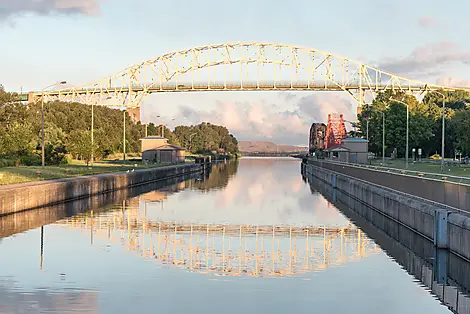
Day 6 - Sault Ste. Marie
Located to the east of the Upper Peninsula of Michigan, Sault Ste. Marie is one of the oldest cities in the United States. Separated from its Canadian twin city by St. Marys River, it is famous among other things for its locks, known as either the Sault Locks or the Soo Locks, which enable ships to travel the metres in change in elevation between Lake Superior and the lower Great Lakes. These locks, which date back over 160Â years, are considered the most important in the world due to their shipping traffic. Make sure you visit the Museum Ship Valley Camp where you can visit the interior of a former freighter that sailed on the Great Lakes for more than 50 years.
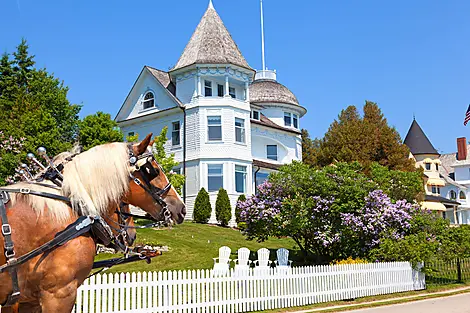
Day 7 - Mackinac Island
Close to the banks of Lake Huron in the State of Michigan, Mackinac Island promises a real journey through time. Originally inhabited by Amerindians, then occupied by French and British colonists, this small island measuring only a few km² still retains an atmosphere of yesteryear today, with its Victorian-style buildings and elegant horse-drawn carriages. Fort Mackinac, on the heights of the island, is a reminder of the conflicts that punctuated the history of this strategic place, a former fur trade centre. In addition to this scenery from the past, the island offers magnificent fine sandy beaches and is home to one of the oldest National Parks in the United States.
Day 7 - Sailing Lake Michigan
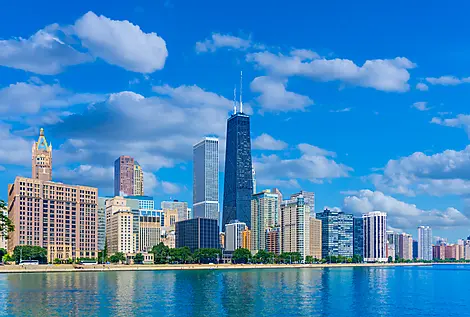
You will sail the United Statesâ largest freshwater body, which gave its name to Michigan, one of the four states that border this lake measuring 500 km long and 200 km wide. The first colonists settled in the south at the end of the 17th century, on the site of the current megalopolis of Chicago. Wild landscapes of forests with sparkling colours, cliffs, golden sandy beaches and dunes as far as the eye can see stretch along its 2,600 km of shoreline. In the north, magnificent wind-swept islands rise out of the lakeâs emerald waters. At 8 km long, the Mackinac Bridge, which spans the straits between Lake Michigan and Lake Huron, is one of the worldâs longest suspension bridges.Â
Day 8 - Milwaukee
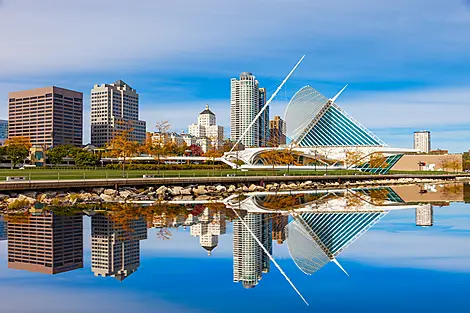
Nested on the shores of Lake Michigan, Milwaukee, the largest city in the State of Wisconsin, harmoniously combines tradition and modernity. Industrial long ago, the city, known as Brew City because of its old breweries renowned all over the world, is experiencing a certain renaissance. While warehouses have given way to restaurants, bars, theatres and art galleries in the city centre, the district still retains traces of its manufacturing past. Further south lies Chicago, the economic centre of the Midwest, with an interesting mix of natural and urban landscapes: its immense skyscrapers, diverse architecture, many parks and magnificent beaches make the city a popular destination.
The Seychelles, under sail aboard the Spirit of Ponant
Cruise Line: Ponant Cruise
Ship: Spirit-Of-Ponant
Sailing Date: Dec 12 2026
Route: Victoria, Mahe - Victoria, Mahe
Duration: 7 Nights
The Seychelles, under sail aboard the Spirit of Ponant
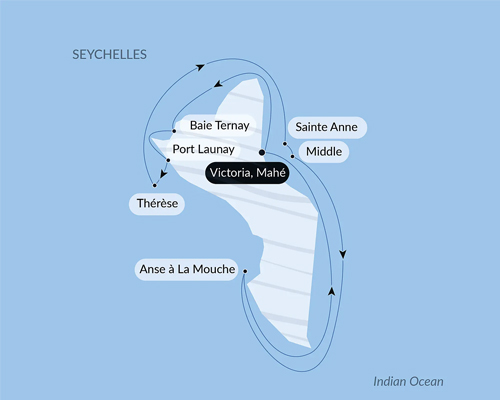
Day 1 - Victoria, Mahe
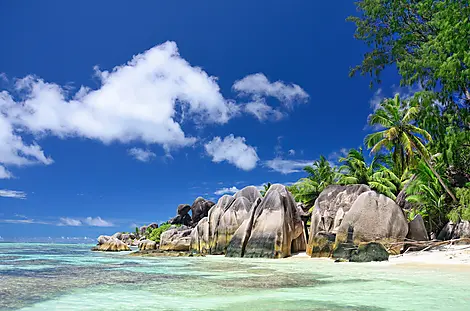
Discover Mahé, the main island of the Seychelles and also the largest of the archipelago, home to the capital, Victoria. Mahé has almost 70 beaches of fine sand, framed by the emblematic granite rocks, and whose crystal clear waters are renowned for their rich underwater life. The island is also famous for its splendid mountain panoramas accessible on hikes, such as the Morne Seychellois, which is 905 metres high and overlooks the Indian Ocean. Mahé is also an island full of history where fine colonial properties rub shoulders with Creole houses - and donât forget the marvellous Botanical Gardens in Victoria.
Day 2 - Baie Ternay Marine National Park
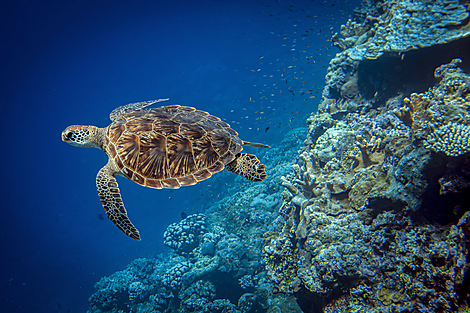
Accessible only by boat or nature trails, Baie Ternay Marine National Park is a wild and pristine sanctuary where nature reigns supreme. Nestled in a secluded bay to the north-west of Mahé, this unspoilt paradise is ideal for getting away from it all. Beneath the surface of the Indian Ocean, a kaleidoscope of marine life flourishes: tropical fish, vibrant corals and sea turtles co-exist in captivating harmony. The lush nature surrounding the bay adds a touch of mystery and grandeur, offering breathtaking views for adventurers in search of untouched landscapes.
Day 3- Port Launay Marine National Park
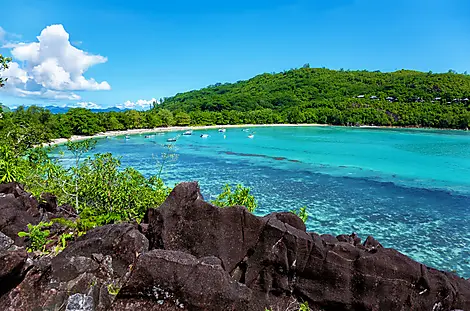
To the north-west of Mahé, Port Launay Marine National Park is a treasure trove of biodiversity. Here, the sea reveals its most precious secrets. Its dazzling blue waters are home to an incredibly rich underwater world, where coral reefs vibrate with life and colour. While snorkelling or scuba diving, come face-to-face with tropical fish, graceful rays, and perhaps even some sea turtles. In this paradise, the mangroves and white-sand beaches enchant visitors, while the surrounding nature invites exploration.
Day 4 - Therese Island
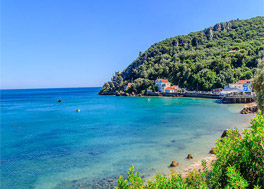
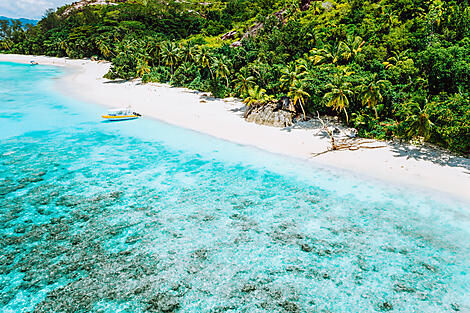
Thérèse is an uninhabited island of the Inner Seychelles. From the heights of this tiny island covered in abundant vegetation, the Mahé summits can be seen. Its tropical beach, a 700-metre long (2,300 feet) ribbon of golden sand lined with coconut trees, is one of the most beautiful in the Seychelles. The crystal-clear waters in shades of turquoise edging this piece of confetti in the Indian Ocean are home to numerous species of multicoloured tropical fish. In this stunning setting, away from the world, the myth of Robinson Crusoe can be reinvented.
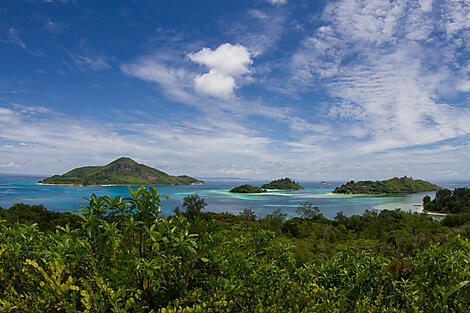
Day 5 - Sainte Anne Marine National Park
Lying off the coast of Mahé, the Sainte Anne Marine National Park has been protecting the natural riches and exceptional sea beds of the verdant islands and turquoise lagoons of Sainte-Anne, Longue, Ronde, Moyenne and Cerf since 1973. These dream islands with their white sandy beaches edged with granite rock, crystal-clear waters and coconut trees promise unforgettable moments of relaxation and discovery. These colourful reefs and granite rocks and their large swathes of seagrass are home to a multitude of tropical fish as well as sea turtles, dolphins and several species of ray, including the manta ray.
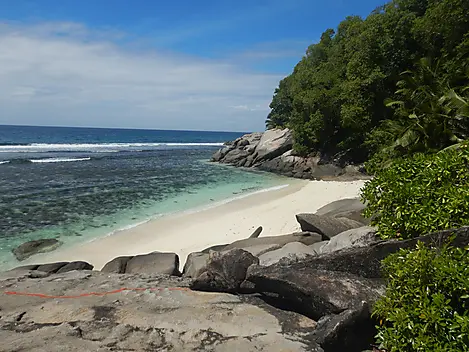
Day 6 - Middle Island
Lost in the heart of the Seychelles archipelago, Moyenne Island is a discreet jewel where time seems to stand still. This natural sanctuary, edged by turquoise waters and immaculate beaches, is a haven of serenity. Stroll along the paths shaded by lush vegetation. Marvel at the giant tortoises, the veritable guardians of this timeless paradise, and discover the islandâs hidden treasures like its mysterious ruins.
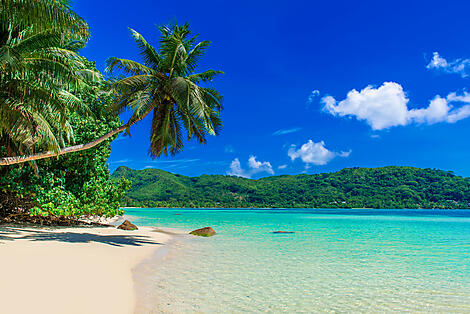
Day 7 - Anse a la Mouche
Nestling in a peaceful bay on the southwestern coast of Mahé, Anse à la Mouche beach will entice you to escape to tropical tranquillity. Its shallow and enchantingly calm crystal-clear waters will invite you in for a serene swim or to paddleboard at the whim of its gentle currents. The white, silky sand stretches out like an immaculate carpet, edged with coconut trees and lush vegetation which whisper beneath the caress of the wind.
Day 8 - Victoria, Mahe
Discover Mahe, the main island of the Seychelles and also the largest of the archipelago, home to the capital, Victoria. Mahé has almost 70 beaches of fine sand, framed by the emblematic granite rocks, and whose crystal clear waters are renowned for their rich underwater life. The island is also famous for its splendid mountain panoramas accessible on hikes, such as the Morne Seychellois, which is 905 metres high and overlooks the Indian Ocean. Mahé is also an island full of history where fine colonial properties rub shoulders with Creole houses - and donât forget the marvellous Botanical Gardens in Victoria.
Christmas Season in Antarctica

Cruise Line: Polar Latitudes Expeditions
Ship: Ocean Victory
Sailing Date: Dec 18 2026
Route: Ushuaia to Ushuaia
Duration: 9 Nights

Christmas Season in Antarctica
Day 1
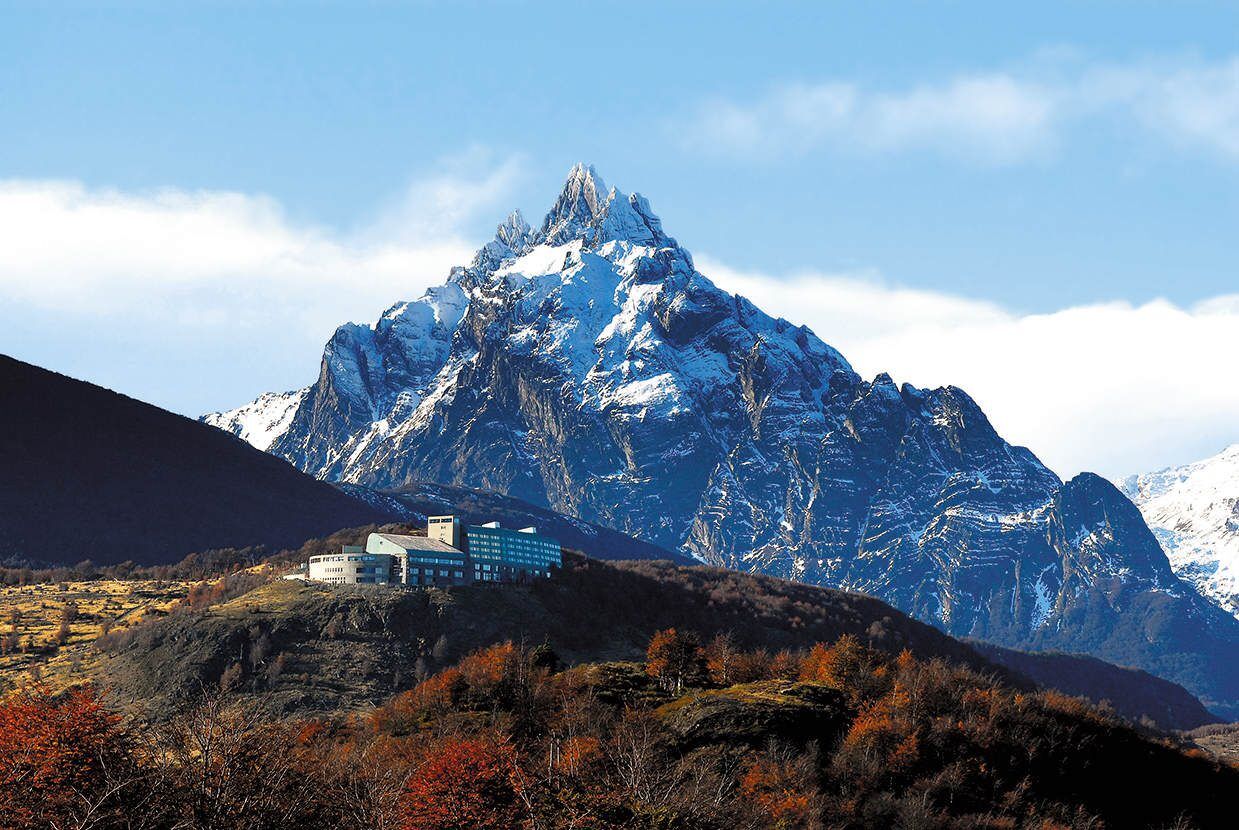 Arrive and explore in Ushuaia
After a friendly welcome at the airport and a transfer to the luxurious Arakur Ushuaia Resort & Spa, take some time to unwind or explore the southernmost city in the world, Ushuaia. (In the unlikely event that you can't be accommodated at the Arakur, you'll unwind at another of Ushuaia's top luxury hotels.)
Our optional evening briefing is your opportunity to ask questions and meet some of your fellow explorers.
Day 2
 All Aboard!
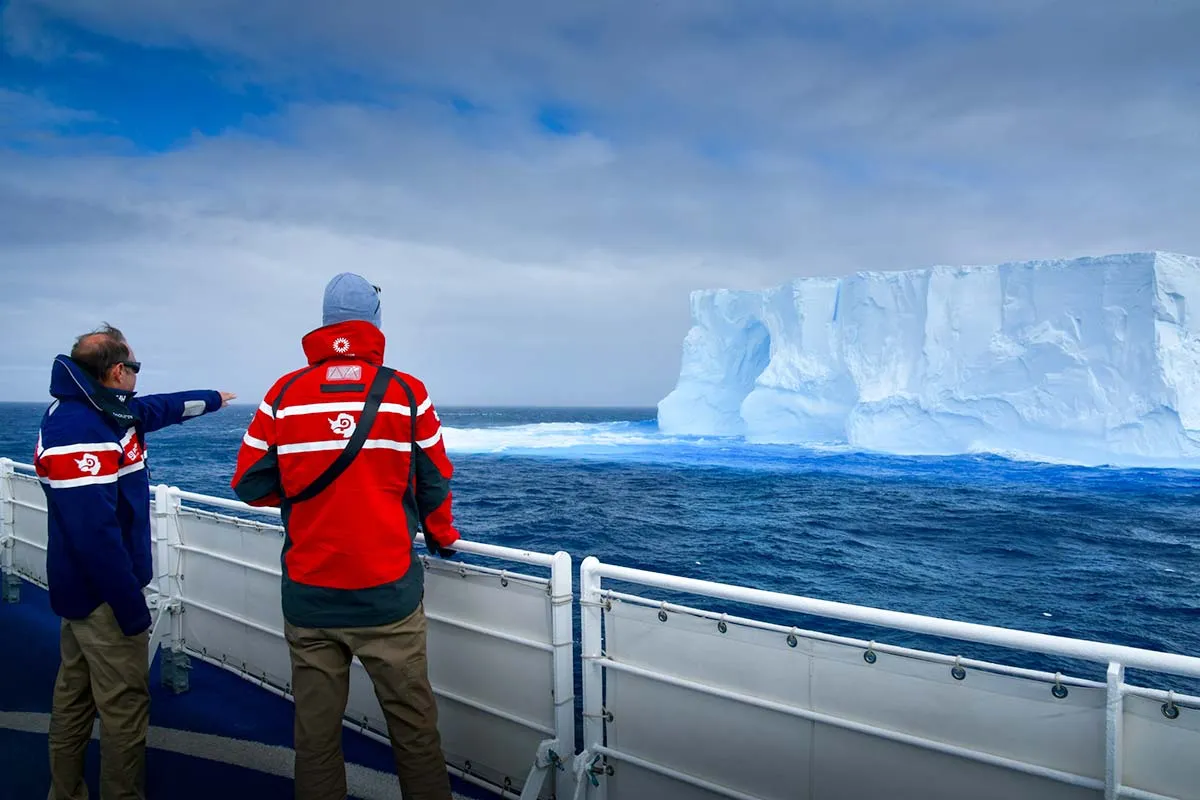
Spend your morning relaxing at the hotel, visiting a museum, or exploring the shops in Ushuaia, before our mid-afternoon escort to the ship. Our Expedition Team and ship staff will welcome you on board and get you settled in, followed by a safety and orientation briefing and our Captainâs welcome dinner. Weâre on our way to Antarctica!
Day 3-4
Drake Passage
Join our Polar Experts as they share their vast knowledge of Antarctica, from its enchanting wildlife to its bold history. Participate in our pioneering Citizen Science program or sit back and take in this fabled journey while catching glimpses of rarely seen wildlife. Keep your binoculars handy to identify the many seabirds that escort our ship as we cross the Antarctic Convergence into Antarcticaâs waters and noticeably cooler temperatures.
Day 5-7
 Merry Christmas, Antarctica!
Time to put our explorerâs spirit to full use. Antarctica offers astounding landscapes and wildlife encounters at every turn, as the last truly unspoiled place on earth, populated only by its original wild inhabitants. Prepare yourself to encounter numerous species of penguins, seals, and whales, who will be there to share the holidays with us along the rugged coastlines and in the sea. Weâll also take full advantage of every opportunity to visit some of the several active scientific bases and historic landing sites on the peninsula. This voyage promises to be a holiday memory youâll cherish forever. Our team always has something fun planned for Christmas Day.
Day 8
 South Shetland Islands
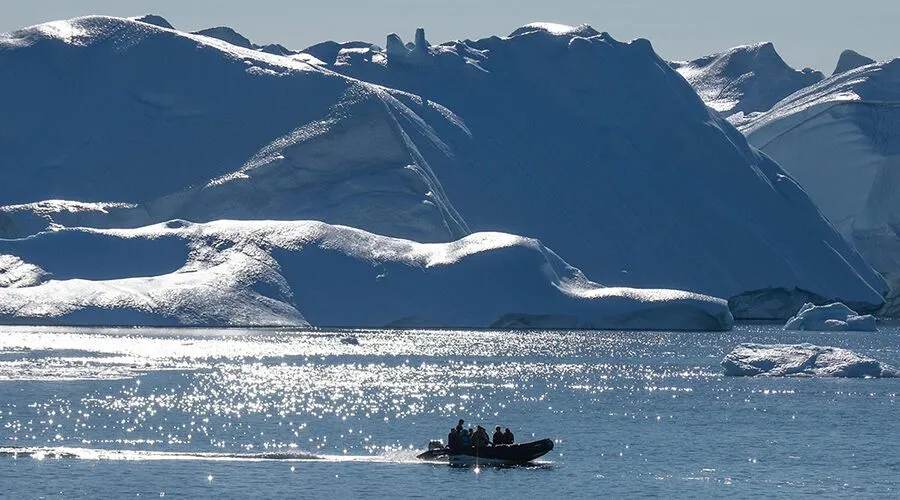
Over time, the volcanic activity of the South Shetland Islands has created a geology unlike any other. Here, you can expect a spectacular display of mountains, glaciers, and wildlife including Chinstrap and Gentoo penguins; and itâs not uncommon to share the waterâs edge with Elephant and Fur seals. Whales are often spotted as well. So, weâll settle into our Zodiacs and spend most of our day exploring. And kayakers, itâs time to get your first taste of gliding just inches off the pristine Antarctic water. Whether on land or sea, in Zodiac or kayak, be prepared for a fully immersive introduction to this incomparable part of the world.
Day 09-10
 Drake Passage
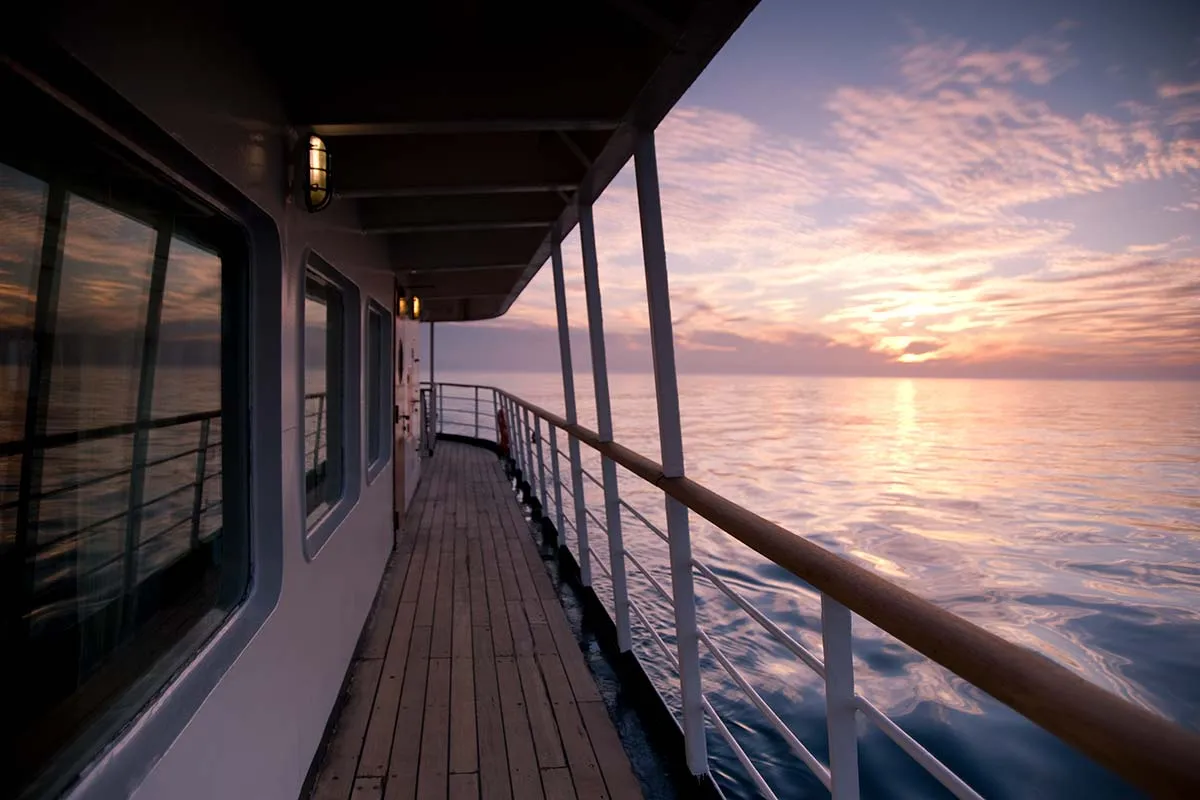
We leave this magical place and make our way north, once again heading across the Antarctic Convergence and the Drake Passage. We have one last hurrah as we celebrate the conclusion of our expedition with a special slideshow and a final meal together.
Day 11
Ushuaia Disembarkation
With huge smiles on weary, content faces, we disembark in the morning, letting you catch a flight to Buenos Aires or stay in Ushuaia for more sights and adventure.
A Voyage Along the Great Lakes - with Smithsonian Journeys
Cruise Line: Ponant Cruise
Ship: Le-Bellot
Sailing Date: Aug 21 2027
Route: Milwaukee - Toronto
Duration: 8 Nights
A Voyage Along the Great Lakes - with Smithsonian Journeys
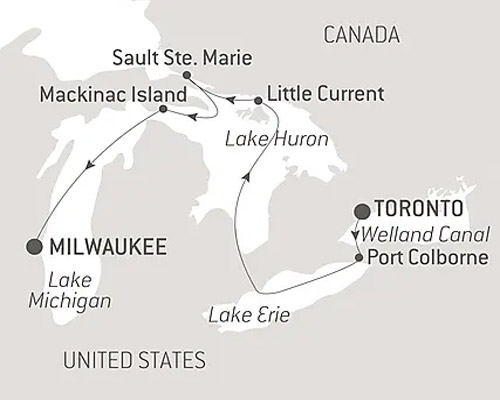
Day 1 - Milwaukee
Nested on the shores of Lake Michigan, Milwaukee, the largest city in the State of Wisconsin, harmoniously combines tradition and modernity. Industrial long ago, the city, known as Brew City because of its old breweries renowned all over the world, is experiencing a certain renaissance. While warehouses have given way to restaurants, bars, theatres and art galleries in the city centre, the district still retains traces of its manufacturing past. Further south lies Chicago, the economic centre of the Midwest, with an interesting mix of natural and urban landscapes: its immense skyscrapers, diverse architecture, many parks and magnificent beaches make the city a popular destination.
Day 2 - Sailing Lake Michigan
You will sail the United Statesâ largest freshwater body, which gave its name to Michigan, one of the four states that border this lake measuring 500 km long and 200 km wide. The first colonists settled in the south at the end of the 17th century, on the site of the current megalopolis of Chicago. Wild landscapes of forests with sparkling colours, cliffs, golden sandy beaches and dunes as far as the eye can see stretch along its 2,600 km of shoreline. In the north, magnificent wind-swept islands rise out of the lakeâs emerald waters. At 8 km long, the Mackinac Bridge, which spans the straits between Lake Michigan and Lake Huron, is one of the worldâs longest suspension bridges.Â
Day 2 - Mackinac Island
Close to the banks of Lake Huron in the State of Michigan, Mackinac Island promises a real journey through time. Originally inhabited by Amerindians, then occupied by French and British colonists, this small island measuring only a few km² still retains an atmosphere of yesteryear today, with its Victorian-style buildings and elegant horse-drawn carriages. Fort Mackinac, on the heights of the island, is a reminder of the conflicts that punctuated the history of this strategic place, a former fur trade centre. In addition to this scenery from the past, the island offers magnificent fine sandy beaches and is home to one of the oldest National Parks in the United States.
Day 3 - Sault Ste. Marie
Located to the east of the Upper Peninsula of Michigan, Sault Ste. Marie is one of the oldest cities in the United States. Separated from its Canadian twin city by St. Marys River, it is famous among other things for its locks, known as either the Sault Locks or the Soo Locks, which enable ships to travel the metres in change in elevation between Lake Superior and the lower Great Lakes. These locks, which date back over 160Â years, are considered the most important in the world due to their shipping traffic. Make sure you visit the Museum Ship Valley Camp where you can visit the interior of a former freighter that sailed on the Great Lakes for more than 50 years.
Day 4 - Little Current
A small port town located along the North Channel of Lake Huron, Little Current is considered to be the gateway to Manitoulin Island, the largest freshwater island in the world. The townâs emblematic construction, the Little Current Swing Bridge built in 1913, provides the only land access to the island, peaceful lands whose name means âthe island of spiritsâ in the local dialect. A real haven of peace, sheltering wild nature and some hamlets, the place is ideal for outdoor activities such as horse-riding and hiking.
Day 5 - Sailing Lake Huron
A natural border between the American State of Michigan and the Canadian province of Ontario, Lake Huron is one of the five American Great Lakes and one of the largest freshwater lakes in the world. Comprising the main lake, Saginaw Bay, the North Channel and Georgian Bay, and home to around 30,000Â islands, it offers varied coastal landscapes and unique views. From your ship, youâll thus be able to admire the wild beauty of the wooded and at times craggy coastline of Manitoulin Island, or the spectacular cliffs of the Bruce Peninsular.
Day 5 - Sailing through Detroit
During your navigation along the Detroit River, an important commercial waterway linking Lake Erie and Lake St. Clair to Lake Huron, you will sail along the largest city in Michigan. Youâll then enjoy panoramic views over the skyscrapers of the former Motor City, jewel of the automotive industry, Fordism and Motown music in the 20th century. Youâll also be able to admire the Ambassador Bridge, which spans the river and enables access to Windsor, on the Canadian shore of the river. This steel suspension bridge, over two kilometres long, was constructed in 1929. This bridge alone carries over 25% of trade between the United States and Canada.
Day 6 - Sailing Lake Erie
Located to the south of Lake Huron and connected to Lake Ontario by the Welland Canal, Lake Erie, which owes its name to one of the Amerindian tribes which peopled its banks before the arrival of the French in the 17th century, is remarkable for its unique ecosystem. Its shallow fish-filled waters make it an excellent fishing spot, while its banks, famous for their many migratory birds, attract photographers and ornithology enthusiasts.
Day 6 - Port Colborne
Port Colborne is a small port city located in southern Ontario, at the mouth of the Welland Canal. It is well-known for one of the longest locks in the world: measuring 420Â metres, this lock, the 8th in the canal, has an observation footbridge and marks the final transit point before the Erie Canal. In addition to the discovery of this tremendous hydraulic infrastructure, this port of call will be your privileged access point to the famous Niagara Falls, renowned all over the world for their spectacular beauty. Located on the river of the same name, which means âwater thunderâ in Amerindian language, these wonders of nature are among the most powerful waterfalls in the world.
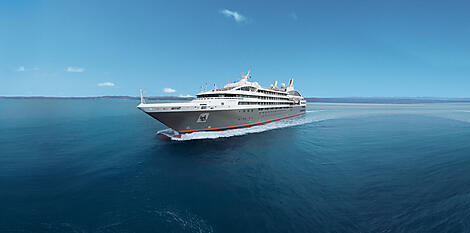
Day 7 - Going through the Welland Canal locks
More than 42 km long, the Welland Canal is part of the Saint Lawrence Seaway and enables ships to travel between Lake Erie and Lake Ontario. With eight locks today, this canal, whose first version dates from 1824, is considered to be one of the major technical constructions of the 20th century. Its completion revolutionised trade in the Great Lakes region by facilitating the transport of goods from the big industrialised cities of Chicago, Cleveland or Milwaukee to the Atlantic Ocean. Sailing along this technological masterpiece is a unique experience that will let you admire the different locks, real jewels of engineering, and enjoy the magnificent surrounding scenery.
Day 8 - Toronto
The largest city in Canada and capital of the province of Ontario, Toronto fascinates as much by its incredible diversity as by its size. Make sure you visit the CN Tower, the tallest tower in the western hemisphere, as well as the St. Lawrence Market whose stalls reflect the multicultural wealth of this city known as the global city. Not far from there, the historic Distillery District unveils its brick-paved streets imbued with romantic charm and its myriad of small restaurants, cafés, boutiques, theatres and art galleries. The Royal Ontario Museum and its impressive collections devoted to the worldâs natural and cultural history will also be an unmissable stop during this port of call.
Crossing the Antarctic Circle
Cruise Line: Polar Latitudes Expeditions
Ship: Ocean Albatros | Ocean Victory
Sailing Date: Jan 21 2027 To Feb 01 2028
Route: Ushuaia to Ushuaia
Duration: 11 Nights

Crossing the Antarctic Circle
Day 1
Arrive and explore in Ushuaia
After a friendly welcome at the airport and a transfer to the luxurious Arakur Ushuaia Resort & Spa, take some time to unwind or explore the southernmost city in the world, Ushuaia. (In the unlikely event that you can't be accommodated at the Arakur, you'll unwind at another of Ushuaia's top luxury hotels.)
Our optional evening briefing is your opportunity to ask questions and meet some of your fellow explorers.
Day 2
All Aboard!
Spend your morning relaxing at the hotel, visiting a museum, or exploring the shops in Ushuaia, before our mid-afternoon escort to the ship. Our Expedition Team and ship staff will welcome you on board and get you settled in, followed by a safety and orientation briefing and our Captainâs welcome dinner. Weâre on our way to Antarctica!
Day 3-4
 Drake Passage
Join our Polar Experts as they share their vast knowledge of Antarctica, from its enchanting wildlife to its bold history. Participate in our pioneering Citizen Science program or sit back and take in this fabled journey while catching glimpses of rarely seen wildlife. Keep your binoculars handy to identify the many seabirds that escort our ship as we cross the Antarctic Convergence into Antarcticaâs waters and noticeably cooler temperatures.
Day 5-9
 SAntarctic Peninsula and Antarctic Circle
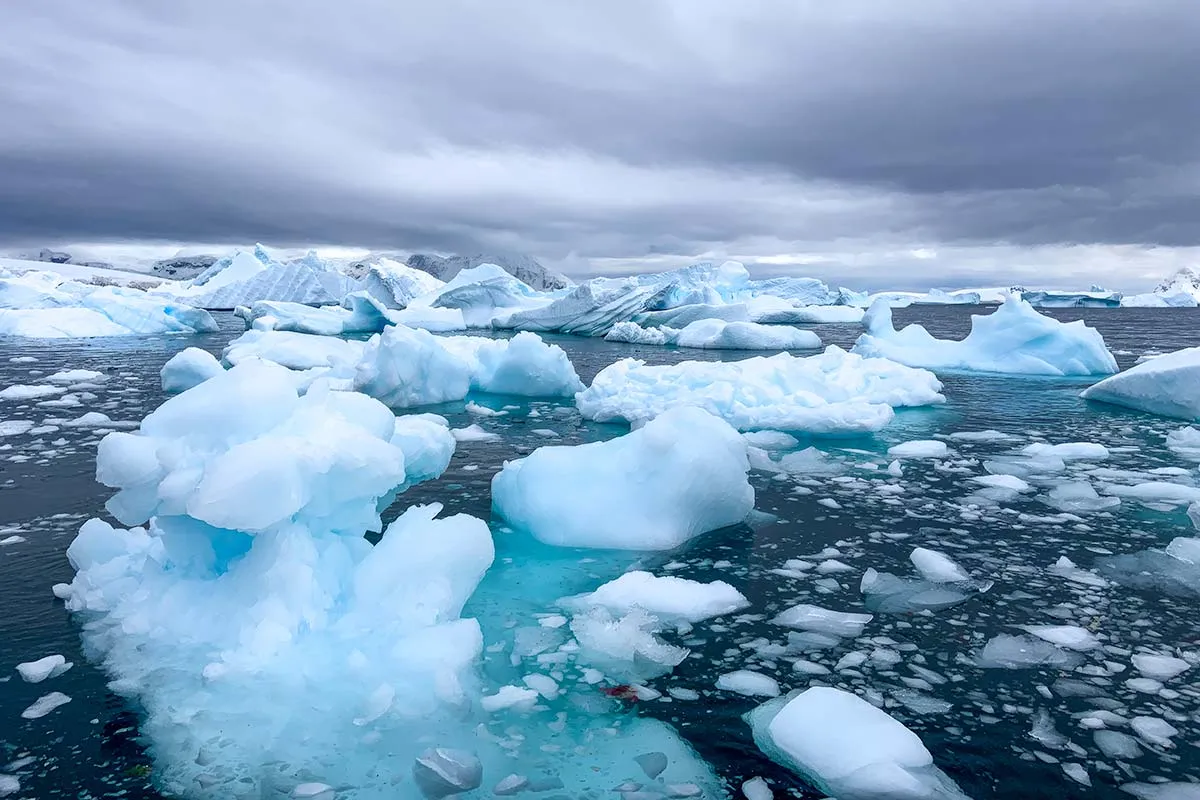
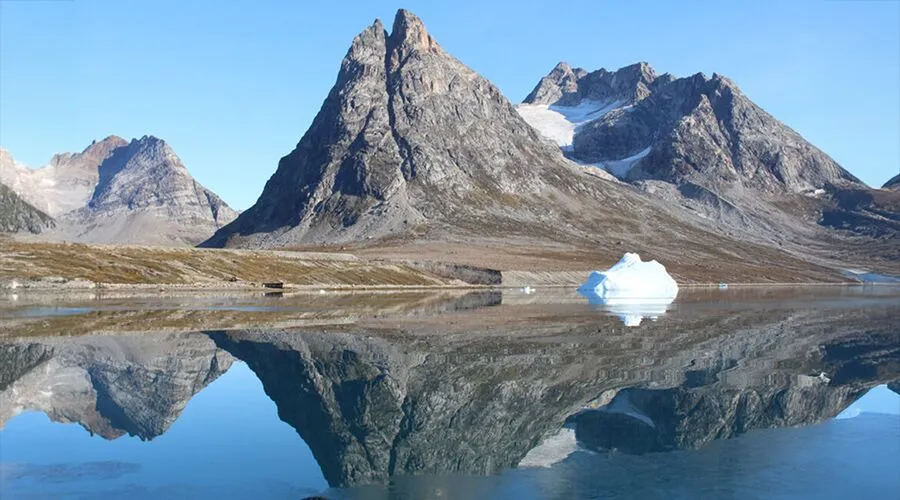
We venture west along the Antarctic Peninsula into the Gerlache Strait region, exploring a variety of sites highlighting the areaâs staggering natural beauty. Iconic experiences await on our twice-daily excursions. From Zodiac cruises into Paradise Bay to witnessing penguins nesting on Cuverville Island, each potential stop promises awe-inspiring encounters. Weâll explore historic huts at Damoy Point, keep an eye out for humpback whales in Wilhelmina Bay, and continue south until we reach the crown jewel of this expedition, the jaw-dropping scenery through the Lemaire Channel. Weather permitting, weâll cross the Antarctic Circle at 66°33âS, an achievement that will put you in rare company.
Day 10
South Shetland Islands
This archipelago represents the northernmost tip of Antarctica, standing proud against the relentless force of the Southern Ocean. The ice-capped peaks of Livingstone, Greenwich, and King George Islands offer a stunning backdrop to explore. And despite the furious elements, the islands boast a remarkable richness of wildlife, with numerous colonies of Gentoo and Chinstrap Penguins dotting the island shores, accompanied by an array of formidable seabirds like the predatory Giant Petrels. Weather permitting, weâll explore the eerie landscape of Deception Island, an active volcanic crater with black steaming sands and rusting ruins, and immerse ourselves in the history of Yankee Harbour, once a vital anchorage for sealers.
Day 11-12
Drake Passage
We leave this magical place and make our way north, once again heading across the Antarctic Convergence and the Drake Passage. We have one last hurrah as we celebrate the conclusion of our expedition with a special slideshow and a final meal together.
Day 13
Ushuaia Disembarkation
With huge smiles on weary, content faces, we disembark in the morning, letting you catch a flight to Buenos Aires or stay in Ushuaia for more sights and adventure.
Australia's Iconic Kimberley

Cruise Line: Ponant Cruise
Ship: Le Soleal | Le-Jacques-Cartier
Sailing Date: May 27 2027 To Aug 25 2028
Route: Darwin - Broome
Duration: 10 Nights
Australia's Iconic Kimberley
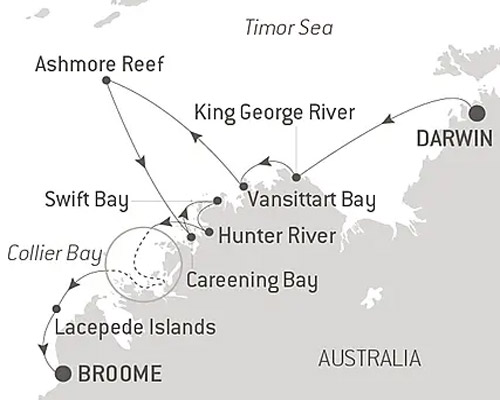
Day 1 - Darwin
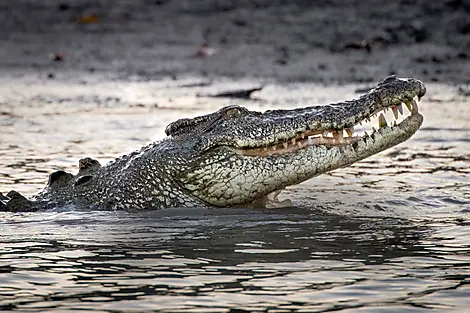
Darwin is located in Australiaâs Northern Territory which is also known as the âTop Endâ. It is the capital city and the most populated town of the Northern Territory. Darwin is a beautiful tropical city, a melting pot of people and cultures, over 50Â different cultures live and work side by side that prides itself in its unique and friendly laid-back lifestyle. Come discover the townâs still recent history through its emblematic buildings such as the new Parliamant House opened in 1994, a magnificent example of tropical architecture or Admiralty House declared heritage place, a tropical-style home elevated on stilts that has survived two cyclones and numerous air raids.
Day 2 - King George River
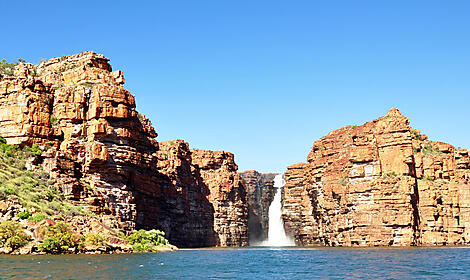
The journey up the King George River is nothing short of breathtaking. The 80-metre-high sides of the gorge display varying degrees of weathering of the ancient Warton sandstone. The colours and textures of the gorge change with the light as you travel further up the river creating a continual changing scenery that is simply stunning. The journey culminates at the King George twin falls; the highest single-drop falls in the whole of the Kimberley (80 m or 260 ft). Fed by wet season run-off the level of water cascading over the falls varies from year to year. Your Expedition Team will escort you in either the zodiacs or ships tenders to the foot of the twin falls, and explain all about the stunning geological formations of the canyon.
Day 3- Vansittart Bay
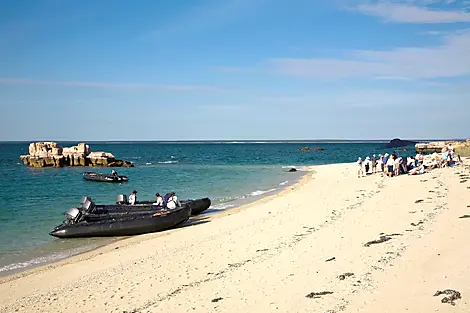
Jar Island contains ancient rock art galleries depicting the Gwion Gwion style unique to the Kimberley region. Mainly neglected by, or unknown to, the early European researchers of Aboriginal culture in the Kimberley in favour of the dominant and more dramatic Wandjina art, Gwion Gwion art has in recent years gained world prominence. It is generally thought that this art may extend back to over 30,000 years before our time and represents the first wave of seagoing colonisers of the Australian continent. As it is, these are the oldest detailed depiction of human figures in the world. Join your Expedition Team ashore for a short walk, past some fascinating rock formations, to the site of the Gwion Gwion art galleries.
Day 4 - Ashmore Reef (technical stop)
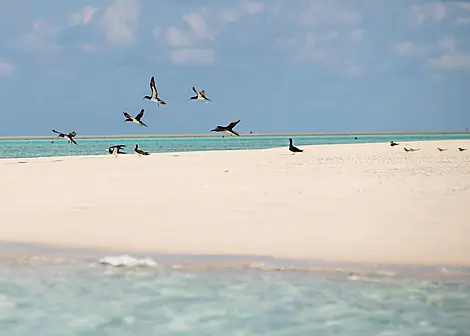
Located 600km North of Broome, on the edge of the continental shelf, Ashmore reef consists of 3 low-lying tropical islands surrounded by coral reef. The islands have a combined land area of approximately 54 hectares and are a designated important bird area (IBA). Visitation to Ashmore reef and Islands is strictly controlled and most of the reef is designated as a sanctuary zone where access is prohibited. Our visit to Ashmore reef is required to ensure we comply with Australian government regulations. Should weather, sea and tide conditions permit there may be an opportunity for guests to undertake a zodiac tour to the vicinity of West Island.
Day 5 - Careening Bay
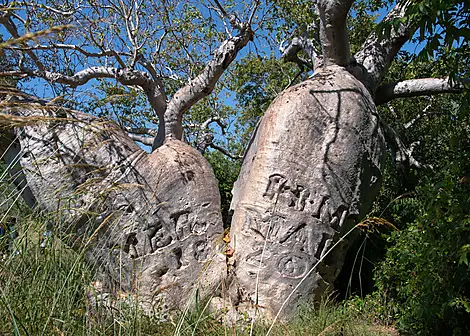
Careening Bay was named by Lieutenant Phillip Parker King after his ship, HMC Mermaid, was careened there during his third voyage of discovery in 1820. King surveyed the western coast to complete the map initiated by Flinders 20 years earlier. The Mermaid had been leaking badly and King needed to find a shallow sandy bay where he could careen his boat to undertake repairs. At a high tide, on a warm September afternoon, he ran the Mermaid onto the sands. For ten days the Mermaid crew worked hard before refloating the vessel. The shipâs carpenter carved the name of the vessel and the year into a conspicuous boab tree. The famous boab tree is now 3 metres wide and National Heritage listed. A reminder of a by gone era of exploration!
Day 6 - Swift Bay
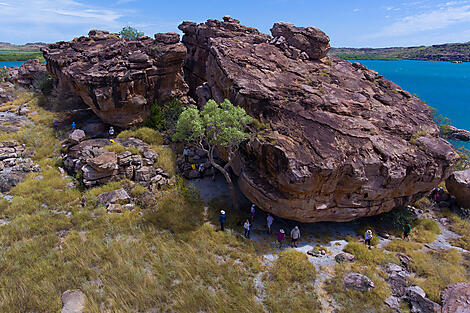
The Bonaparte Archipelago, is a stunningly rugged maze of islands stretching almost 150 km along Western Australia's remote Kimberley coast. Its colour and scale conspire to take onesâ breath away. Its distant location has meant it has remained an unspoilt and remarkably pristine location to explore and experience. Phillip Parker King named âSwift's bay" after Jonathon Swift (1667-1745) the author of Gulliverâs travels. The âTâ shaped bay is composed of heavily fractured sandstone providing an abundance of rock shelters. On the walls of these shelters are examples of both Wandjina and Gwion Gwion style rock art. Join your expedition team ashore for a guided walk to a number of rock art galleries depicting these unique rock art styles.
Day 7 - Hunter River
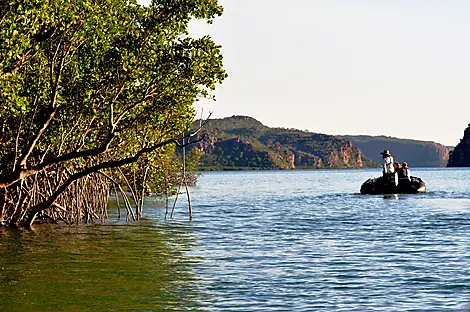
Arguably one of the most scenic parts of the Kimberley coast, Prince Frederick Harbour and the Hunter River are lined with ancient rainforest pockets, pristine mangroves and mosaic sandstone cliffs. They are considered to be some of the most pristine mangrove forests in the world, containing up to 18 different species, supporting a rich and diverse fauna. The sandstone escarpment at the river mouth, known as âKampamantiyaâ rises over 200 metres high before giving way to extensive mud banks and mangrove forests home to numerous bird species and the iconic saltwater crocodile. Our expert Expedition Team will share their knowledge with you as you explore this pristine mangrove environment by zodiac keeping a constant lookout for wildlife. You will also have the opportunity to reach the Mitchell Falls by helicopter from Naturalist Island beach.Â
1 available excursions
Mitchell Falls helicopter flight & landing
Day 8-9 - Collier Bay
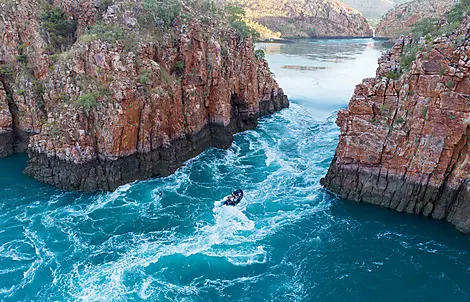
Lying to the east of the Buccaneer archipelago, the ancient landscapes of Collier Bay have been shaped by the massive tidal movements the region is renowned for, creating a photographerâs paradise. With a tidal range exceeding 14 metres, recorded near Yule entrance at the southern end of the bay, they are among the largest in the world. This massive daily movement of water creates unique phenomena that occur nowhere else in the world. Nestled in the centre of the Bay is Montgomery Reef, the worldâs largest inshore reef system. As the tide falls a raging torrent of water cascades off the top of the reef, creating turbulent âriversâ and mini waterfalls. At the Southern end of the Bay, Talbot Bay is home to the worldâs only âHorizontal Fallsâ described by Sir David Attenborough as âOne of the greatest wonders of the natural world.â Hidden in the many caves and grottos of this ancient landscape are a multitude of ancient Rock Art galleries. Here you can find spectacular examples of the Wandjina and Gwion Gwion styles. Â
As we are at the mercy of weather and tide conditions in this region, the activities mentioned above are only possible experiences and canât be guaranteed.
Day 10 - Lacepede Islands
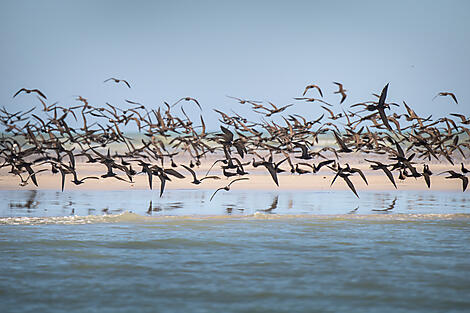
The Lacepede Islands are Western Australiaâs most important breeding habitat for Green Turtles (Chelonia mydas), and have been named by BirdLife International as an Important Bird Area (IBA). The breeding colony of Brown Boobies is possibly the largest in the world. Up to 20,000 Roseate Terns have also been recorded here. Other birds breeding on the islands include Masked Boobies, Australian Pelicans, Lesser Frigatebirds, Eastern Reef Egrets, Silver Gulls, Crested, Bridled and Lesser Crested Terns, Common Noddies, Pied and Sooty Oystercatchers. Join your expedition team for a guided zodiac tour to view the prolific wildlife. Due to the sensitive nature of the environment, landings are prohibited on the Lacepede Islands.
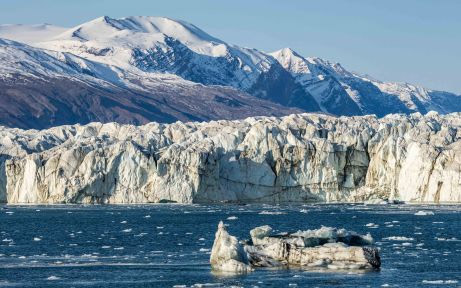
Complete East Greenland
Cruise Line: Albatros Expeditions
Ship: Ocean Albatros
Sailing Date: Sep 17 2027
Route: Reykjavik, Iceland to Reykjavik, Iceland
Duration: 11 Nights

Fjords and glaciers of Spitsbergen
Cruise Line: Ponant Cruise
Ship: Le-Lyrial
Sailing Date: Jun 19 2027 To Jun 23 2028
Route: Longyearbyen, Spitsbergen (Norway) to Longyearbyen, Spitsbergen (Norway)
Duration: 7 Nights
Fjords and glaciers of Spitsbergen
Ports of Call & Excursions
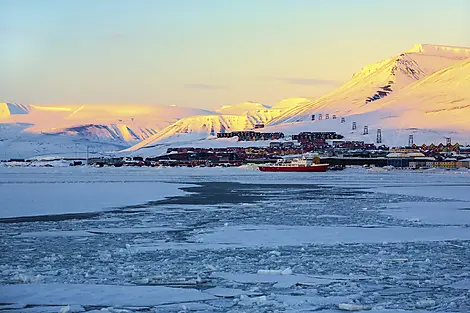
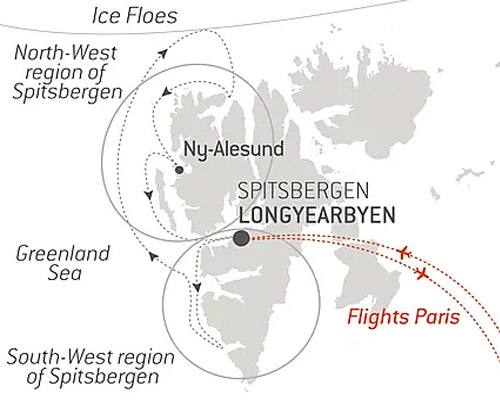
Day 1 - Longyearbyen, Spitsbergen
Longyearbyen is the capital of the Norwegian Svalbard archipelago, located on Svalbardâs main island, and is the northernmost territorial capital on the planet. With winter temperatures dropping to below 40°C, the landscapes of this mining town are simply breathtaking. The glaciers, the mountains stretching as far as the eye can see and the untouched nature, make you feel like youâre in completely unexplored territory.
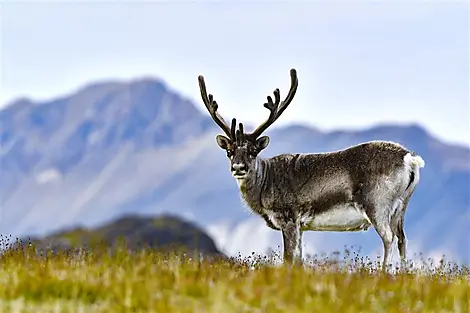
Day 2Â Â - 3 - South-West Region of Spitsbergen
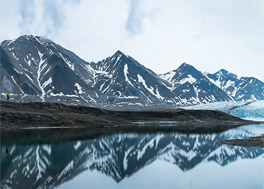
Set sail for southwest Spitsbergen, immerse yourself in this environment unlike any other and explore its unexpected riches. In this natural sanctuary, the polar light combines with the changing weather of the Arctic, a big blue sky, the horizon scattered with clouds, the enveloping mist erasing the border between the land and the sea. Follow in the footsteps of the first explorers and admire the majestic fjords and glaciers sculpting the breathtaking landscapes, their icy waters shimmering beneath the midnight sun. The fjords, veritable cathedrals of ice, reveal their millennial secrets, while the glaciers, like sleeping giants, move slowly towards the sea, setting free sparkling icebergs. On the water, you might spot belugas and rorquals, while on the shores, seals and Arctic foxes add a touch of mystery to this living tableau, where the steep cliffs become breeding grounds for thousands of seabirds, like guillemots. Southwest Spitsbergen is an ode to nature in its rawest and purest form.
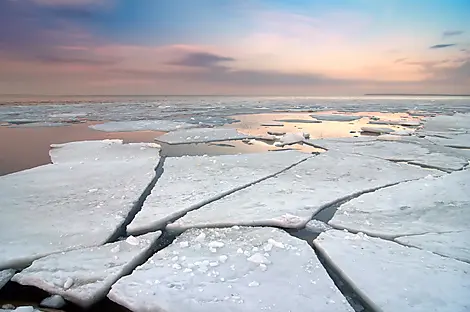
Day 4 - Sailing toward the ice floes
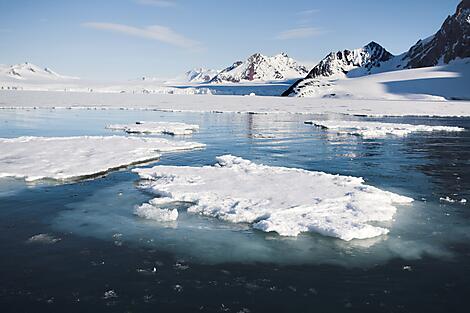
Your captain will sail right up to the limit of the ice, to the edge of the ice floe. Weather conditions and state of the ice allowing, you will be able to go out in a zodiac dinghy for a unique experience in the middle of these floating slabs of ice. In addition to this grandiose journey through the middle of these floes with their cut and blue-tinged edges, sometimes over 2 metres thick, it is also often an opportunity to see a particular kind of fauna, totally dependent on the ice floe: birds, seals and polar bears.
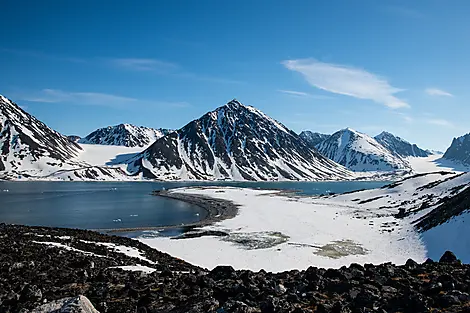
Day 5Â Â - 6 - North-West region of Spitsbergen
A kingdom of contrasts and natural marvels dotted with islands and peninsulas, northwest Spitsbergen fascinates with its preserved beauty. On these pristine lands, infinity unveils itself, treating the eyes to beauty sculpted by nature and enhanced by the changing light. The fjords bathed by icy waters, the jagged mountains and the imposing glaciers stand majestically before you, like monumental sculptures. In these lands, where souls are filled with deep serenity, only the murmur of broken ice, bearing mysteries and legends, disturbs the calmness. Aboard our Zodiacs and in the company of naturalist-guides, get as close as possible to this unique fauna and discover this centre for scientific expedition departures. In the distance, majestic whales glide silently through the glacial waters, whereas seals, walrus and Arctic foxes add.
Day 7 - Ny-Alesund, Spitsbergen
During your cruise, discover Ny-Ã lesund, a former mining town that has been transformed into a scientific base. Founded in 1916, this small town was the departure point for many Arctic expeditions, including those of the famous explorer Roald Amundsen. Don't miss a visit to the museum and its famous post office, considered to be the most northerly in the world!
Day 8 - Longyearbyen, Spitsbergen
Longyearbyen is the capital of the Norwegian Svalbard archipelago, located on Svalbardâs main island, and is the northernmost territorial capital on the planet. With winter temperatures dropping to below 40°C, the landscapes of this mining town are simply breathtaking. The glaciers, the mountains stretching as far as the eye can see and the untouched nature, make you feel like youâre in completely unexplored territory.
Ultimate Antarctic Circle Crossing
Cruise Line: Polar Latitudes Expeditions
Ship: Mv Discoverer | Ocean Albatros
Sailing Date: Jan 27 2027 To Mar 01 2028
Route: Ushuaia to Ushuaia
Duration: 13 Nights

Ultimate Antarctic Circle Crossing
Day 1
Arrive and explore in Ushuaia
After a friendly welcome at the airport and a transfer to the luxurious Arakur Ushuaia Resort & Spa, take some time to unwind or explore the southernmost city in the world, Ushuaia. (In the unlikely event that you can't be accommodated at the Arakur, you'll unwind at another of Ushuaia's top luxury hotels.)
Our optional evening briefing is your opportunity to ask questions and meet some of your fellow explorers.
Day 2
All Aboard! Seaventure!
Spend your morning relaxing at the hotel, visiting a museum, or exploring the shops in Ushuaia, before our mid-afternoon escort to the ship. Our Expedition Team and ship staff will welcome you on board and get you settled in, followed by a safety and orientation briefing and our Captainâs welcome dinner. Weâre on our way to Antarctica!
Day 3-4
Drake Passage
Join our Polar Experts as they share their vast knowledge of Antarctica, from its enchanting wildlife to its bold history. Participate in our pioneering Citizen Science program or sit back and take in this fabled journey while catching glimpses of rarely seen wildlife. Keep your binoculars handy to identify the many seabirds that escort our ship as we cross the Antarctic Convergence into Antarcticaâs waters and noticeably cooler temperatures.
Day 5
South Shetland Islands
Over time, the volcanic activity of the South Shetland Islands has created a geology unlike any other. Here, you can expect a spectacular display of mountains, glaciers, and wildlife, including Chinstrap and Gentoo penguins, and itâs not uncommon to share the waterâs edge with Elephant and Fur seals. Whales are often spotted as well. So, weâll settle into our Zodiacs and kayaks and spend most of our day exploring. Whether on land or sea, in Zodiac or kayak, be prepared for a fully immersive introduction to this incomparable part of the world.
Day 6-9
Achieving the Antarctic Circle
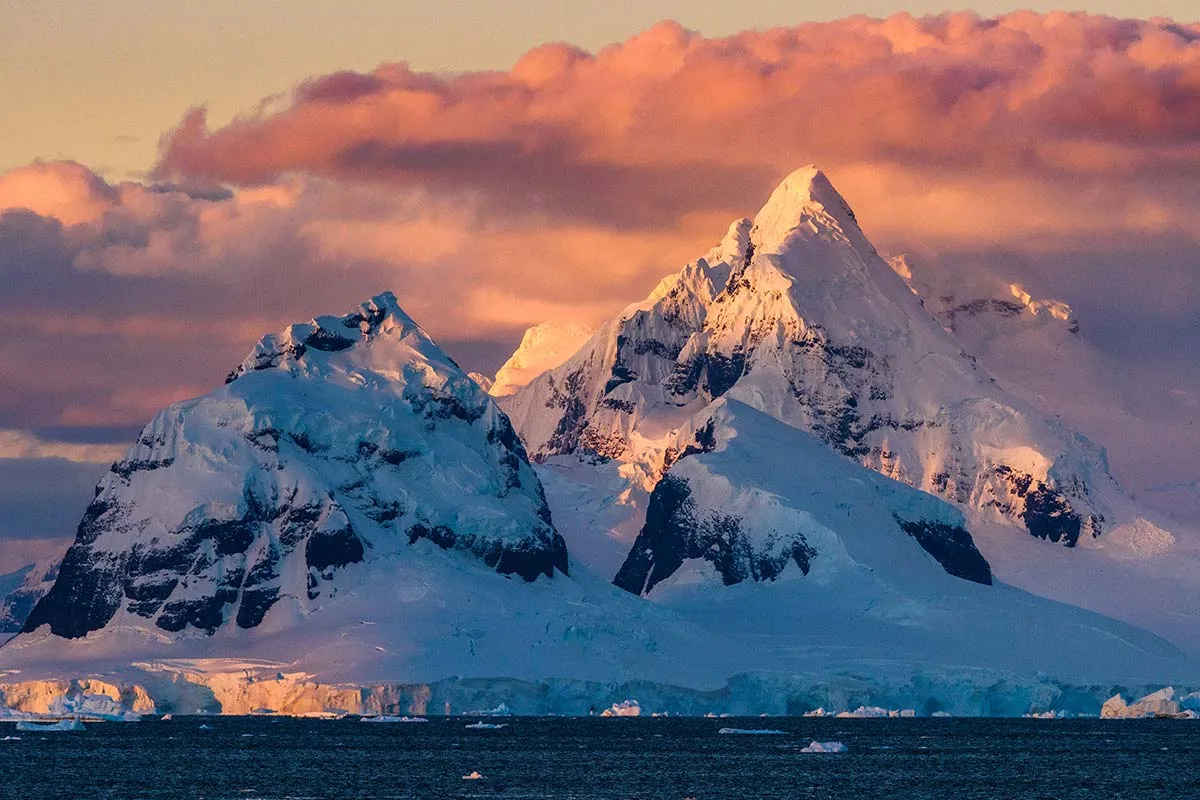
Heading south across the Bransfield Strait, we begin to see the breathtaking outline of the Antarctic Peninsula. Wildlife sightings, including penguins, whales, and fur seals, become more frequent, as do dramatic sculptural icebergs. With extra time to explore, possibilities abound. Weâll look to visit historic sites like the huts at Damoy Point, keep an eye out for humpback whales in Wilhelmina Bay, and continue our twice-daily outings until we reach the crown jewel of this expedition, the jaw-dropping scenery through the Lemaire Channel. Weather permitting, weâll cross the Antarctic Circle at 66°33âS, an achievement that will put you in rare company. Following a tradition first established by sailors crossing the equator, weâll celebrate the occasion by⦠(Sorry, you just have to be there), before heading onward toward any number of historic and rarely visited British Survey bases, after which we turn back north.
Day 10-12
 Antarctic Peninsula
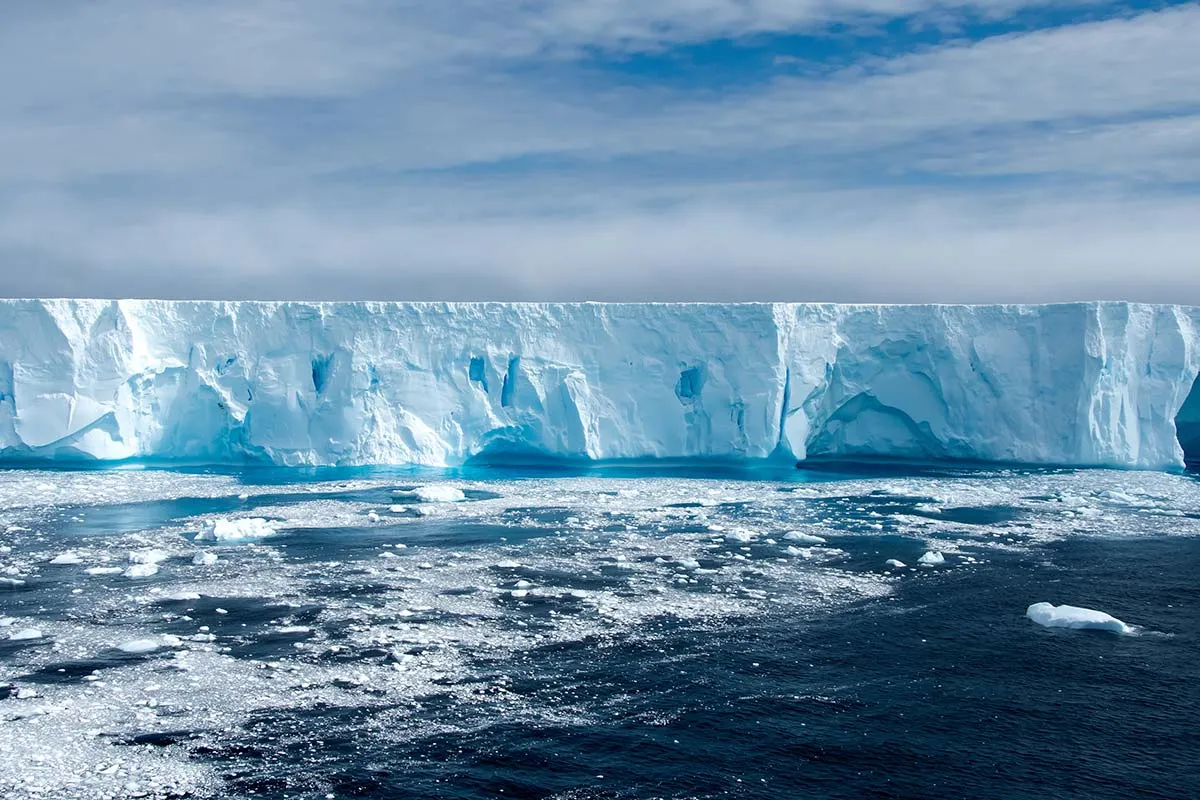
Heading north, weâll explore all the Antarctic Peninsula has to offer, including any number of spectacular bays and famed landing sites, maneuvering through dramatic channels as we traverse the wildlife-rich waters, encountering a wide variety of lively penguins, seals, and whales along the rugged coastlines and in the sea. There are always great opportunities to stop at several active scientific bases and historic landing sites along the way, as we leave no opportunity unseized upon in our quest to explore the very best of this magical place.
Day 13-14
Drake Passage
We leave this magical place and make our way north, once again heading across the Antarctic Convergence and the Drake Passage. We have one last hurrah as we celebrate the conclusion of our expedition with a special slideshow and a final meal together.
Day 15
Ushuaia Disembarkation
With huge smiles on weary, content faces, we disembark in the morning, letting you catch a flight to Buenos Aires or stay in Ushuaia for more sights and adventure.
Extended Antarctic Circle Crossing
Cruise Line: Polar Latitudes Expeditions
Ship: Mv Discoverer
Sailing Date: Dec 28 2026
Route: Ushuaia to Ushuaia
Duration: 12 Nights

Extended Antarctic Circle Crossing
Day 1
Arrive and explore in Ushuaia
After a friendly welcome at the airport and a transfer to the luxurious Arakur Ushuaia Resort & Spa, take some time to unwind or explore the southernmost city in the world, Ushuaia. (In the unlikely event that you can't be accommodated at the Arakur, you'll unwind at another of Ushuaia's top luxury hotels.)
Our optional evening briefing is your opportunity to ask questions and meet some of your fellow explorers.
Day 2
All Aboard!
Spend your morning relaxing at the hotel, visiting a museum, or exploring the shops in Ushuaia, before our mid-afternoon escort to the ship. Our Expedition Team and ship staff will welcome you on board and get you settled in, followed by a safety and orientation briefing and our Captainâs welcome dinner. Weâre on our way to Antarctica!
Day 3-4
Drake Passage
Join our Polar Experts as they share their vast knowledge of Antarctica, from its enchanting wildlife to its bold history. Participate in our pioneering Citizen Science program or sit back and take in this fabled journey while catching glimpses of rarely seen wildlife. Keep your binoculars handy to identify the many seabirds that escort our ship as we cross the Antarctic Convergence into Antarcticaâs waters and noticeably cooler temperatures.
Day 5
South Shetland Islands
Over time, the volcanic activity of the South Shetland Islands has created a geology unlike any other. Here, you can expect a spectacular display of mountains, glaciers, and wildlife, including Chinstrap and Gentoo penguins, and itâs not uncommon to share the waterâs edge with Elephant and Fur seals. Whales are often spotted as well. So, weâll settle into our Zodiacs and kayaks and spend most of our day exploring. Whether on land or sea, in Zodiac or kayak, be prepared for a fully immersive introduction to this incomparable part of the world.
Day 6-9
Achieving the Antarctic Circle
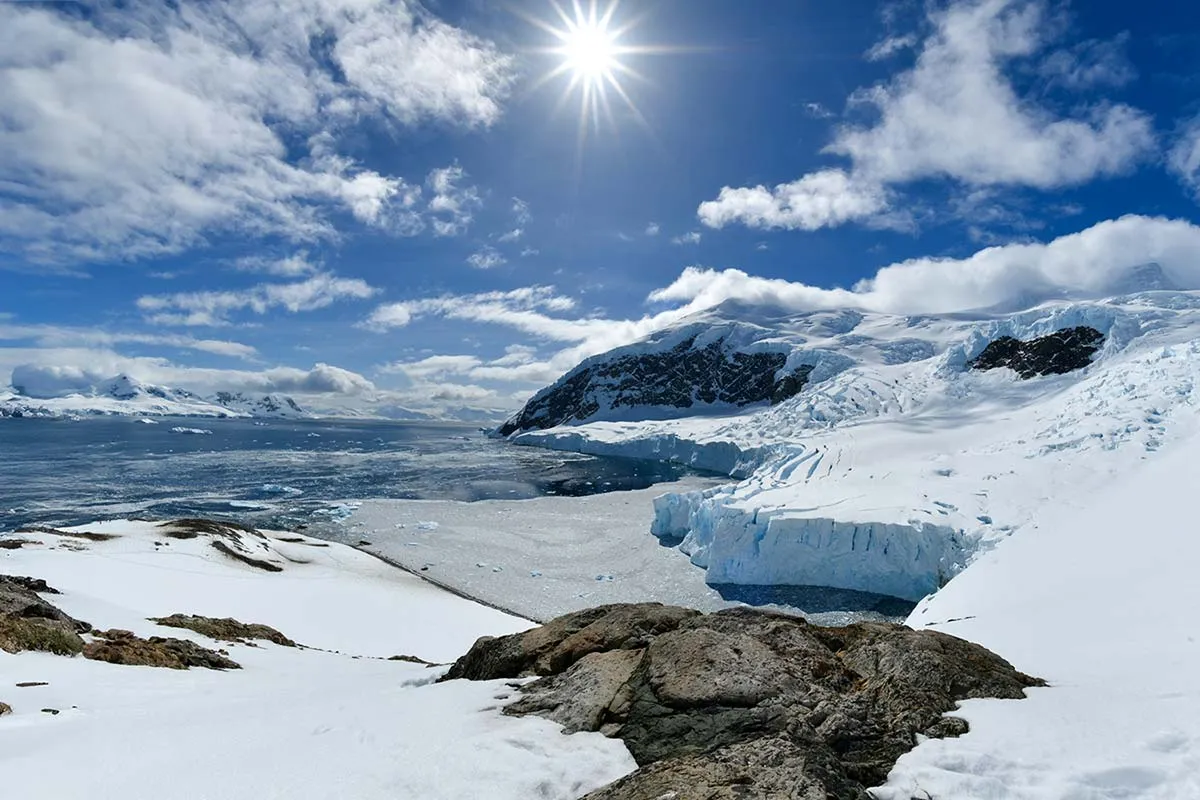
We venture west along the Antarctic Peninsula into the Gerlache Strait region, exploring a variety of sites highlighting the areaâs staggering natural beauty. Iconic experiences await on our twice-daily excursions. From Zodiac cruises into Paradise Bay to witnessing penguins nesting on Cuverville Island, each potential stop promises awe-inspiring encounters. Weâll explore historic huts at Damoy Point, keep an eye out for humpback whales in Wilhelmina Bay, and continue south until we reach the crown jewel of this expedition, the jaw-dropping scenery through the Lemaire Channel. Weather permitting, weâll cross the Antarctic Circle at 66°33âS, an achievement that will put you in rare company.
Day 10-11
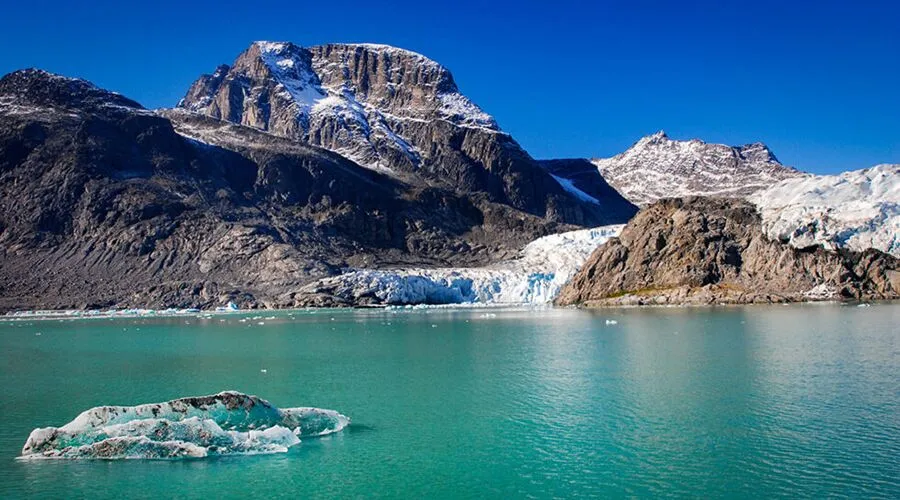 South Shetland Islands
This archipelago represents the northernmost tip of Antarctica, standing proud against the relentless force of the Southern Ocean. The ice-capped peaks of Livingstone, Greenwich, and King George Islands offer a stunning backdrop to explore. And despite the furious elements, the islands boast a remarkable richness of wildlife, with numerous colonies of Gentoo and Chinstrap Penguins dotting the island shores, accompanied by an array of formidable seabirds like the predatory Giant Petrels. Weather permitting, weâll explore the eerie landscape of Deception Island, an active volcanic crater with black steaming sands and rusting ruins, and immerse ourselves in the history of Yankee Harbour, once a vital anchorage for sealers.
Day 12-13
Drake Passage
We leave this magical place and make our way north, once again heading across the Antarctic Convergence and the Drake Passage. We have one last hurrah as we celebrate the conclusion of our expedition with a special slideshow and a final meal together.
Day 14
Ushuaia Disembarkation
With huge smiles on weary, content faces, we disembark in the morning, letting you catch a flight to Buenos Aires or stay in Ushuaia for more sights and adventure.

We Accept: 
Secured By: 
Copyright © STIC GSA Services Pvt. Ltd. All rights reserved