

Exploring Antarctica's Spring
Cruise Line: Polar Latitudes Expeditions
Ship: Ocean Albatros | Ocean Victory
Travel Period: Nov 04 2026
Port: Ushuaia to Ushuaia
Duration: 11 Days

Exploring Antarctica's Spring
Day 1
 Arrive and explore in Ushuaia
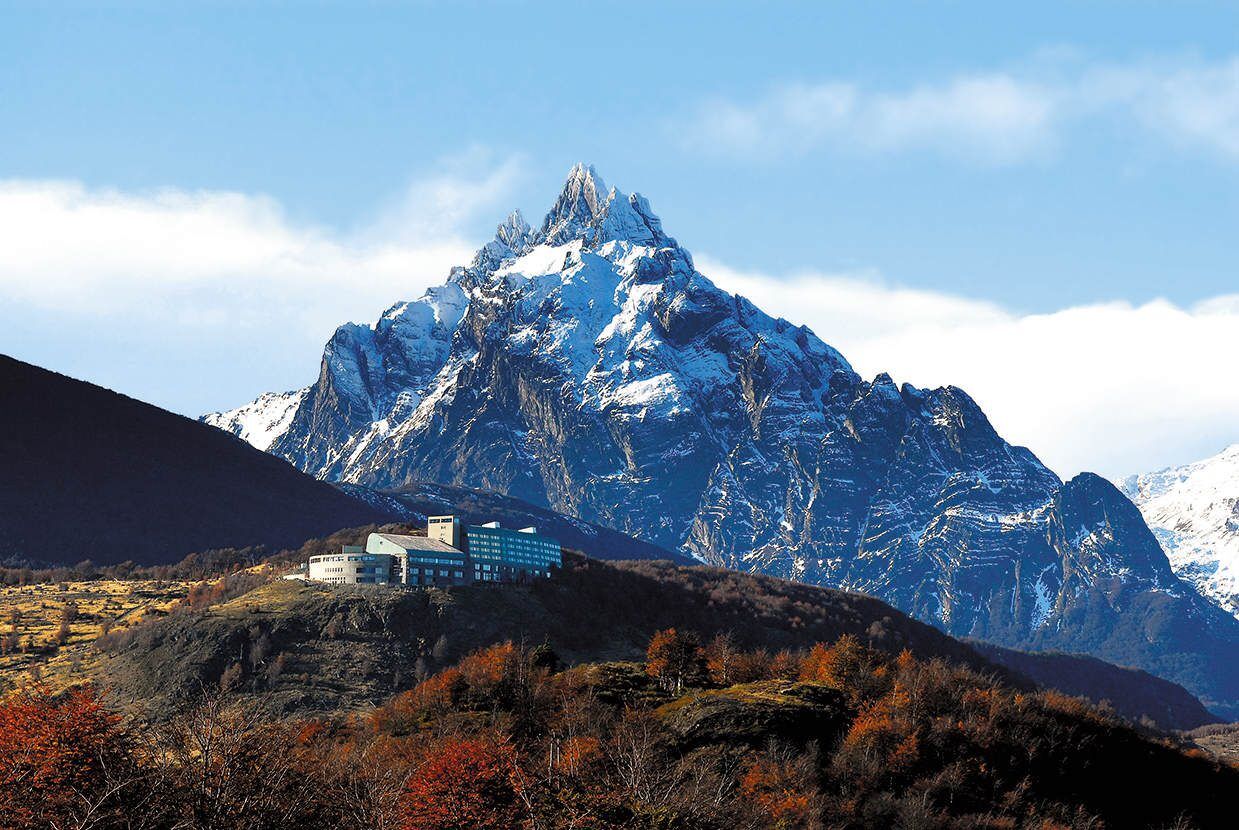
After a friendly welcome at the airport and a transfer to the luxurious Arakur Ushuaia Resort & Spa, take some time to unwind or explore the southernmost city in the world, Ushuaia. (In the unlikely event that you can't be accommodated at the Arakur, you'll unwind at another of Ushuaia's top luxury hotels.)
Our optional evening briefing is your opportunity to ask questions and meet some of your fellow explorers.
Day 2
 All Aboard!
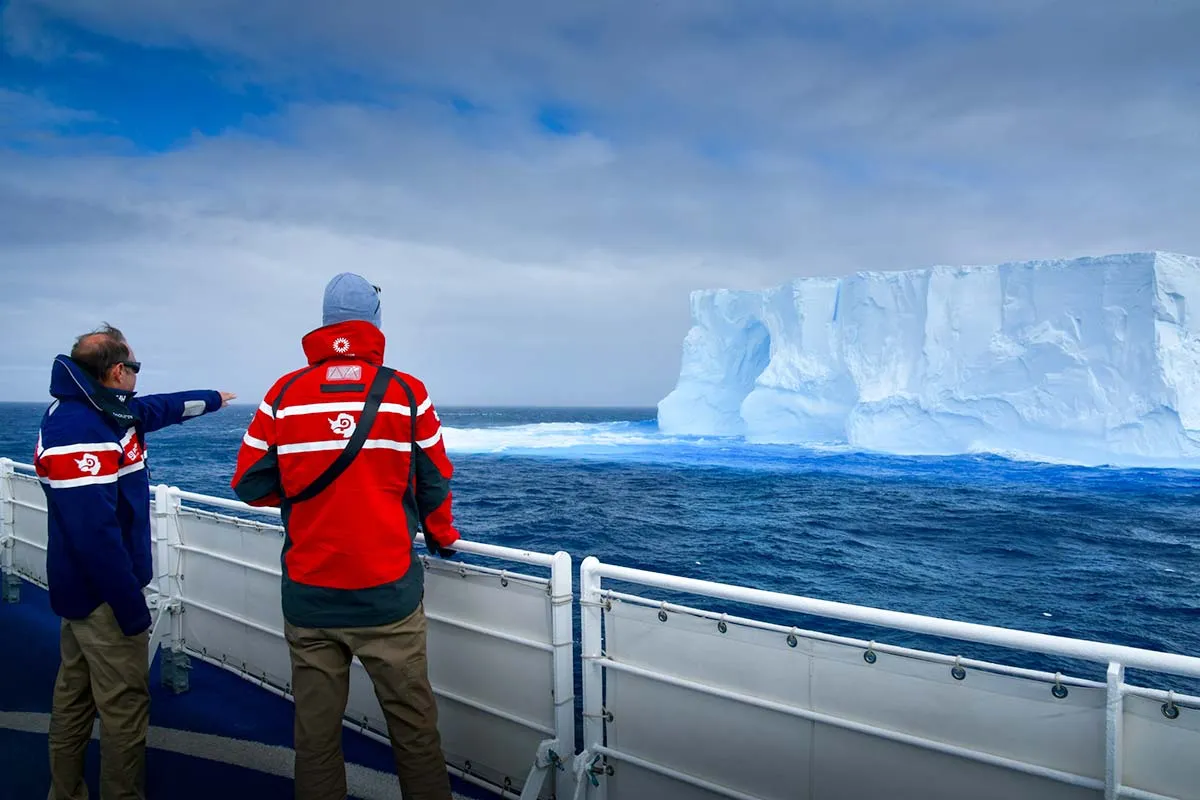
Spend your morning relaxing at the hotel, visiting a museum, or exploring the shops in Ushuaia, before our mid-afternoon escort to the ship. Our Expedition Team and ship staff will welcome you on board and get you settled in, followed by a safety and orientation briefing and our Captainâs welcome dinner. Weâre on our way to Antarctica!
Day 3-4
Drake Passage
Join our Polar Experts as they share their vast knowledge of Antarctica, from its enchanting wildlife to its bold history. Participate in our pioneering Citizen Science program or sit back and take in this fabled journey while catching glimpses of rarely seen wildlife. Keep your binoculars handy to identify the many seabirds that escort our ship as we cross the Antarctic Convergence into Antarcticaâs waters and noticeably cooler temperatures.
Day 5
 South Shetland Islands
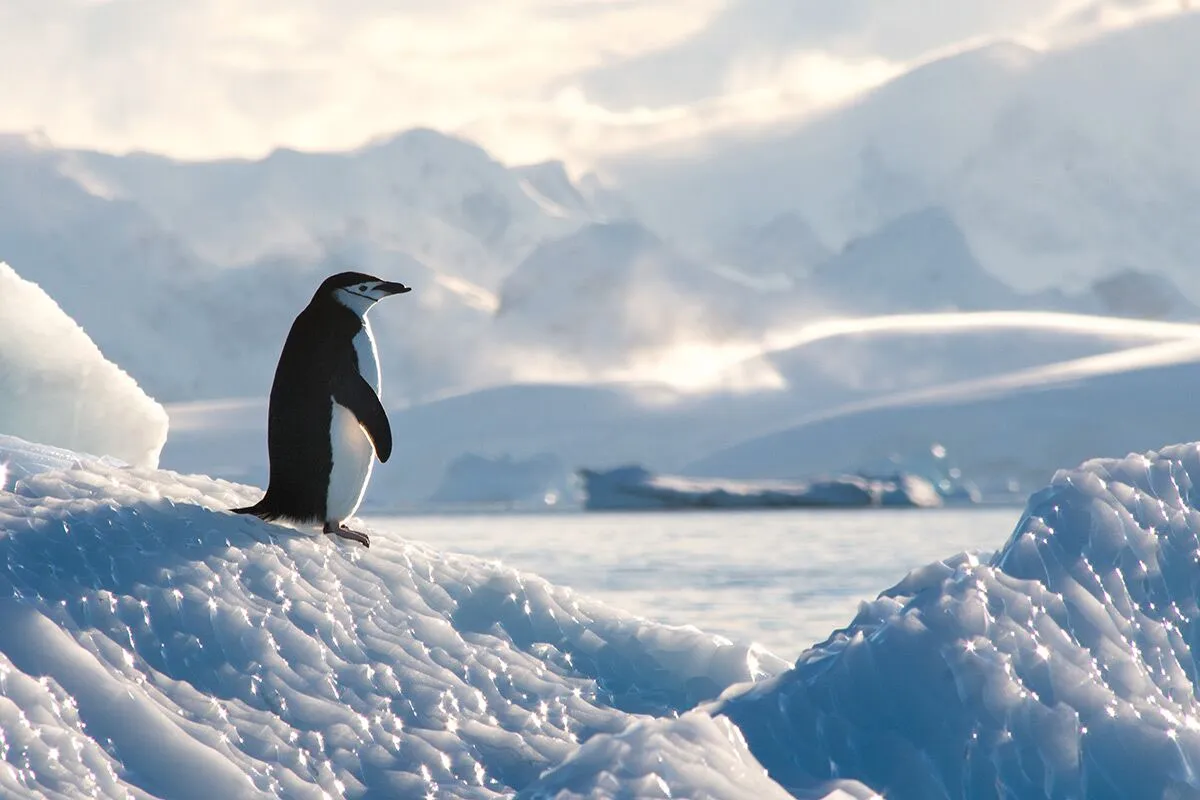
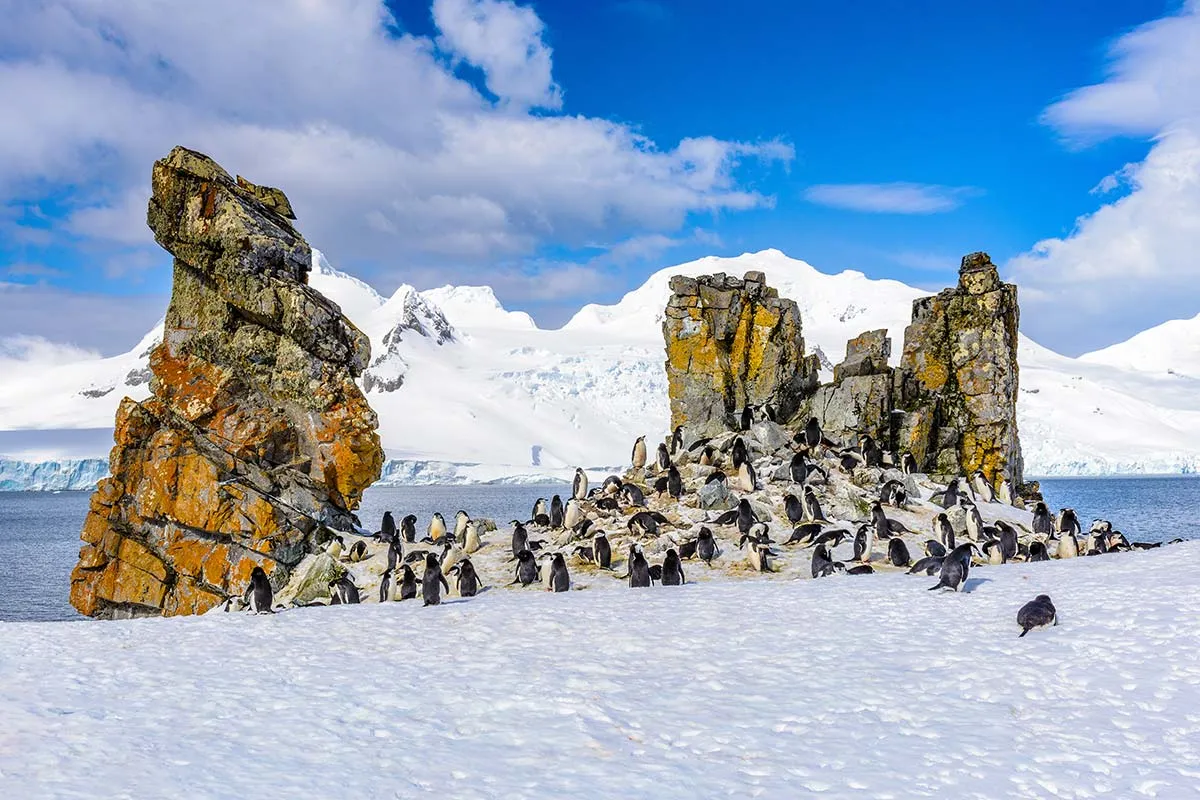
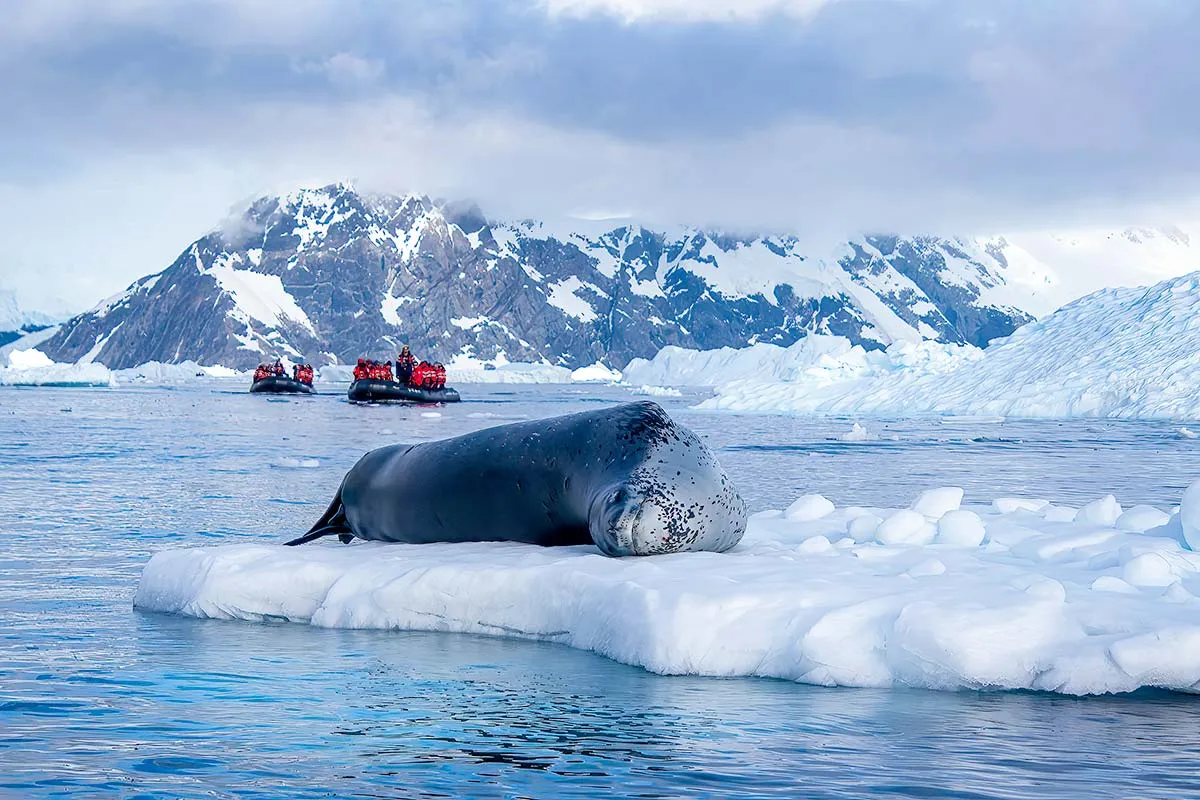
Over time, the volcanic activity of the South Shetland Islands has created a geology unlike any other. Here, you can expect a rugged display of mountains, glaciers, and wildlife returning to their busy daily activity after the long winter break. Chinstrap and Gentoo penguins will be a common sight, and itâs not uncommon to share the waterâs edge with Elephant and Fur seals. Whales are often spotted as well. So, weâll settle into our Zodiacs and spend most of our day exploring, perhaps stopping for a walk along the black sands of Deception Island. Whether on land or sea, in a Zodiac or kayak, be prepared for a fully immersive introduction to this incomparable part of the world.
Day 6-8
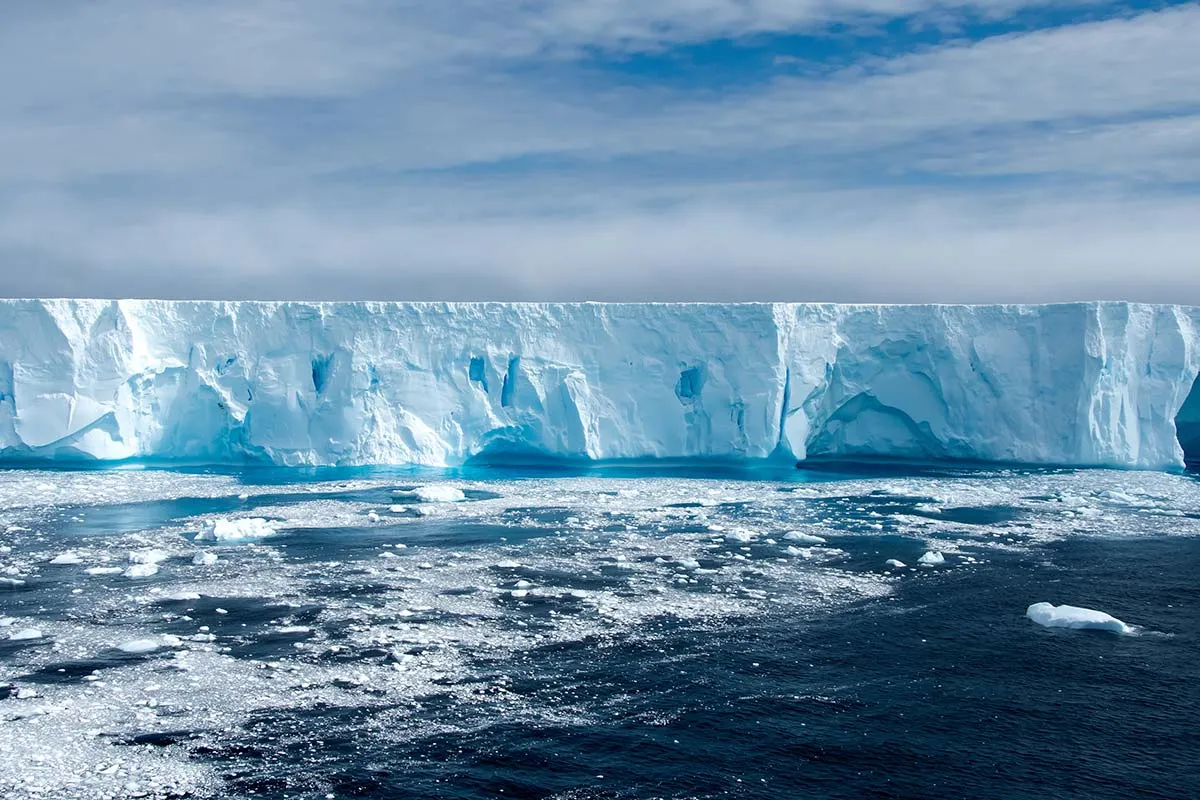 Antarctica in the Spring
Welcome to Antarctica in all its just-waking-up-from-winter glory. Untouched. Pristine. Getting busy. For the next couple of days, prepare to be amazed as we observe numerous species of penguins coming ashore and getting acquainted, building nests, and tending their eggs. Marvel at the winter sea ice that mantles these frigid seas, feast your eyes on glorious icebergs beginning the springtime march, and, as always, be on the lookout for seals and whales in the water. At dayâs end, take in the miraculous sunsets that are a special treat this time of year. Visits to active scientific bases and historic landing sites may also be on the agenda.
Day 9-10
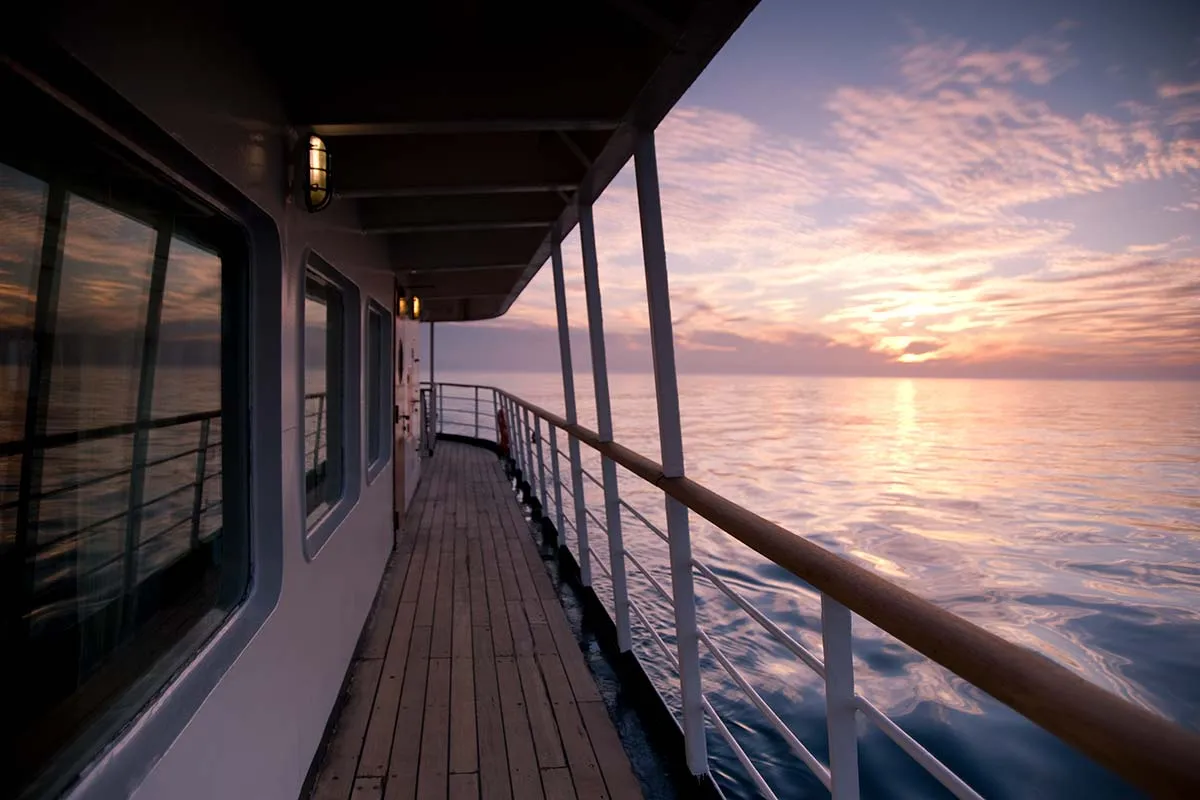 Drake Passage
We leave this magical place and make our way north, once again crossing the legendary Drake Passage. We have one last hurrah as we celebrate the conclusion of our expedition with a special slideshow and a final meal together.
Day 11
Ushuaia Disembarkation
With huge smiles on weary, content faces, we disembark in the morning, letting you catch a flight to Buenos Aires or stay in Ushuaia for more sights and adventure.
Antarctica's Whale Season
Cruise Line: Polar Latitudes Expeditions
Ship: Ocean Albatros
Travel Period: Mar 09 2027 - Mar 18 2027
Port: Ushuaia to Ushuaia
Duration: 11 Days

Antarctica's Whale Season
Day 1
Arrive and explore in Ushuaia
After a friendly welcome at the airport and a transfer to the luxurious Arakur Ushuaia Resort & Spa, take some time to unwind or explore the southernmost city in the world, Ushuaia. (In the unlikely event that you can't be accommodated at the Arakur, you'll unwind at another of Ushuaia's top luxury hotels.)
Our optional evening briefing is your opportunity to ask questions and meet some of your fellow explorers.
Day 2
All Aboard!
Spend your morning relaxing at the hotel, visiting a museum, or exploring the shops in Ushuaia, before our mid-afternoon escort to the ship. Our Expedition Team and ship staff will welcome you on board and get you settled in, followed by a safety and orientation briefing and our Captainâs welcome dinner. Weâre on our way to Antarctica!
Day 3-4
 Drake Passage
Join our Polar Experts as they share their vast knowledge of Antarctica, from its enchanting wildlife to its bold history. Participate in our pioneering Citizen Science program or sit back and take in this fabled journey while catching glimpses of rarely seen wildlife. Keep your binoculars handy to identify the many seabirds that escort our ship as we cross the Antarctic Convergence into Antarcticaâs waters and noticeably cooler temperatures.
Day 5-6
 South Shetland Islands
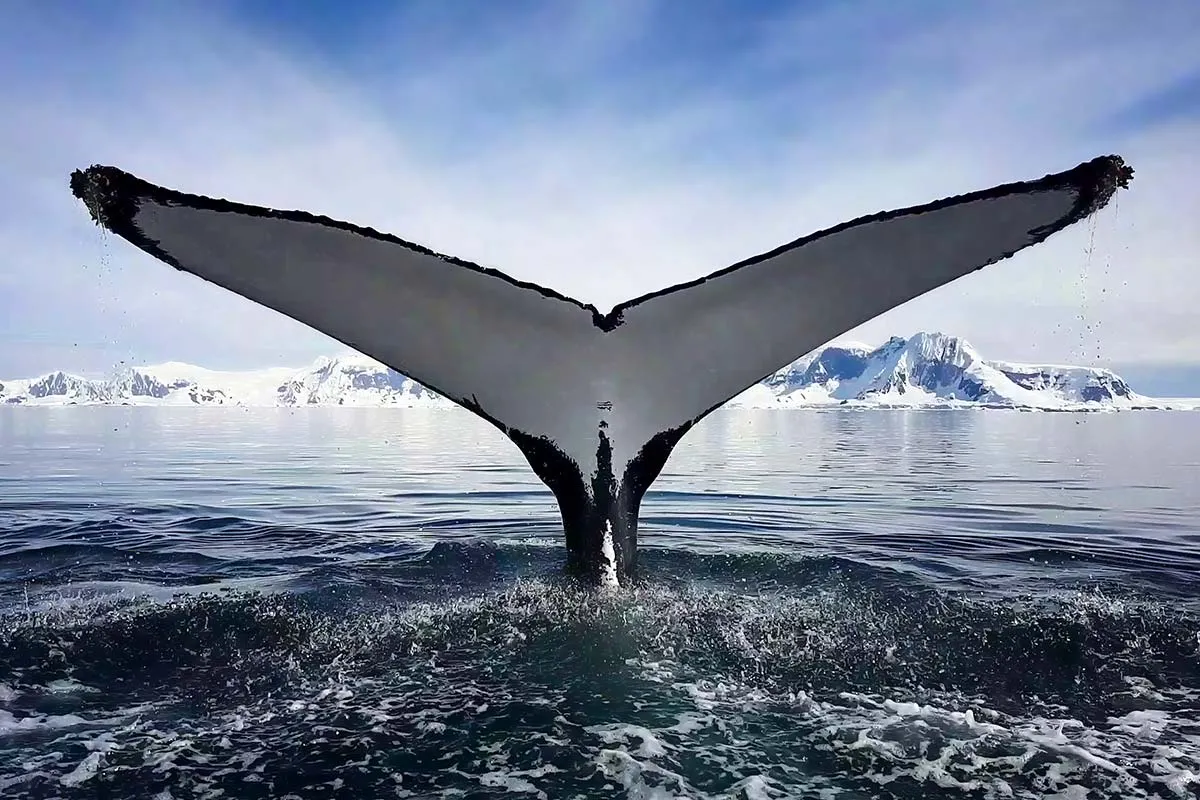
The South Shetlands are 12 islands separated from the Antarctic Peninsula by the Bransfield Strait. Significant volcanic activity has sculpted a geology â and a diverse natural beauty â unlike anywhere else on Earth. Here, you can expect a spectacular display of mountains, glaciers, and wildlife, including Chinstrap and Gentoo penguins, and itâs not uncommon to share the waterâs edge with Elephant and Fur seals. And this time of year is feeding time for Humpback whales, so donât be surprised if youâre joined by a number of them on your dayâs adventure.
Day 7-8
 Antarctica (and Whales) Await
On to the Antarctic Peninsula, where weâll explore any number of stunning bays and famed harbors, maneuvering through majestic channels as we continue to travel these wildlife-rich waters, passing a number of glorious icebergs along the way. Weâll have great opportunities to stop at several active scientific bases and historic landing sites as we direct our attention and our cameras toward numerous species of penguins, seals, and whales along the rugged coastlines and in the sea. As always throughout this journey, be on the lookout for the impressive population of Humpback, Minke, and Orca whales feeding in the water.
Day 9-10
Drake Passage
We leave this magical place and make our way north, once again crossing the legendary Drake Passage. We have one last hurrah as we celebrate the conclusion of our expedition with a special slideshow and a final meal together.
Day 11
Ushuaia Disembarkation
With huge smiles on weary, content faces, we disembark in the morning, letting you catch a flight to Buenos Aires or stay in Ushuaia for more sights and adventure.
Cruising Southern Spain and Portugal - with Smithsonian Journeys
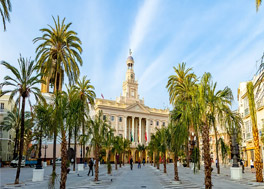
Travel Period: Oct 17 2026
Port: Barcelona to Lisbon
Duration: 9 Days
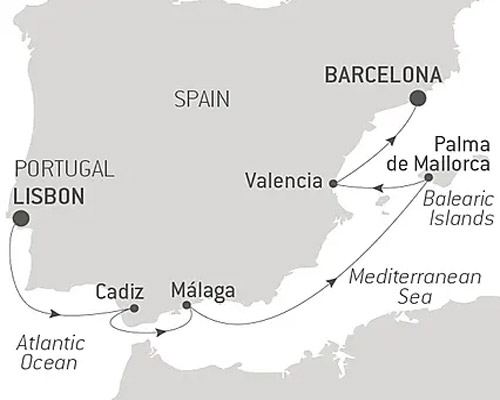
Cruising Southern Spain and Portugal - with Smithsonian Journeys
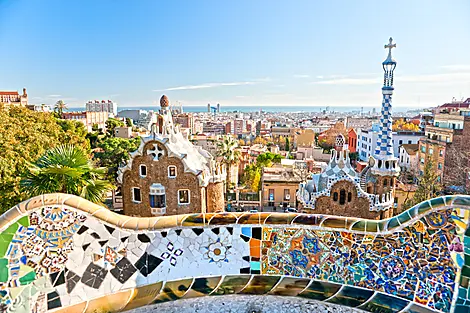
Day 1 - Barcelona
Located on the seashore between the mountains of Montjuïc and Tibidabo, Barcelona offers its many visitors a perfect blend of tradition and modernism. Truly an open-air museum, the âprodigious townâ reveals an astonishing range of artistic treasures and museums, combining Roman ruins, medieval districts and a number of avant-garde elements from the 20th Century. Over the years, it has been marked by some of the greatest artists, such as Picasso, Miró or GaudÃ, most of whose work has been listed as World Heritage Sites by UNESCO. Take the time to stroll along the Ramblas and enjoy the gentle, typically Mediterranean lifestyle of the capital of Catalonia.
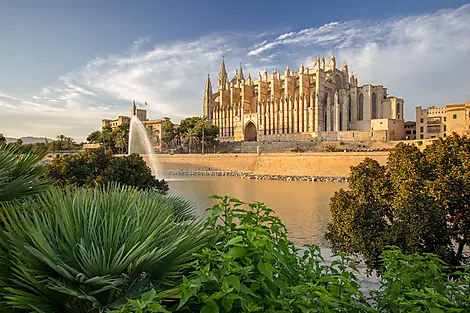
Day 2 - Palma de Mallorca, Balearic Islands
Palma de Mallorca will reveal its many treasures: idyllic coves, majestic limestone cliffs that plunge into the clear sapphire- and turquoise-coloured waters of the Mediterranean, and vast plains planted with almond trees, olive trees and vineyards. When your ship calls at the capital of the Balearic Islands, take a walk to discover its emblematic monuments, such as its famous cathedral, and amble through its old streets. Here, like a painting, the islandâs historical heritage forms a backdrop to the lively and warm cosmopolitan atmosphere of the Mediterranean.
3 available excursions
Fundacio Miro Mallorca & Palma City, Mallorca by Vintage Train, Marivent Gardens and Palma's Old Town
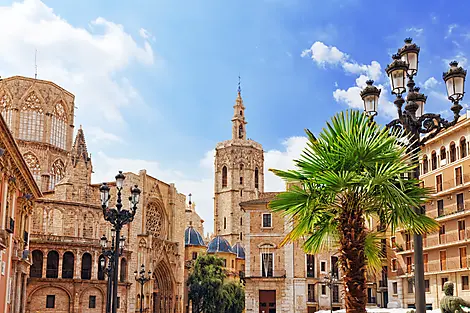
Day 3 - Valencia
Valencia - the city of Art and Sciences. Two hearts beat in this Spanish city: one is modern, avantgarde and almost futuristic; the other is more provincial, more traditional and nostalgic. Valencia has the temperament of a great Mediterranean city whose wide avenues form a border around the old town. The city has an abundance of architectural styles that coexist harmoniously, but above all it resolutely embraces the 21st Century with the futuristic structures of its Agora congress centre and City of Arts and Sciences, emerging from a crystal blue pool.
3 available excursions
Albufera Natural Park & Lagoon Cruise, Treasures of Valencia, Valencia, Old and New
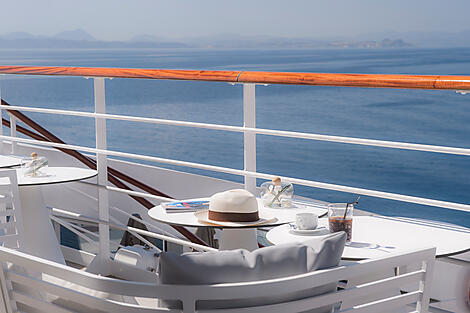
Day 4 - At sea
During your journey at sea, make the most of the many services and activities on board. Treat yourself to a moment of relaxation in the spa or stay in shape in the fitness centre. Depending on the season, let yourself be tempted by the swimming pool or a spot of sunbathing. This journey without a port of call will also be an opportunity to enjoy the conferences or shows proposed on board, depending on the activities offered, or to do some shopping in the boutique or to meet the PONANT photographers in their dedicated space. As for lovers of the open sea, they will be able to visit the shipâs upper deck to admire the spectacle of the waves and perhaps be lucky enough to observe marine species. A truly enchanted interlude, combining comfort, rest and entertainment.
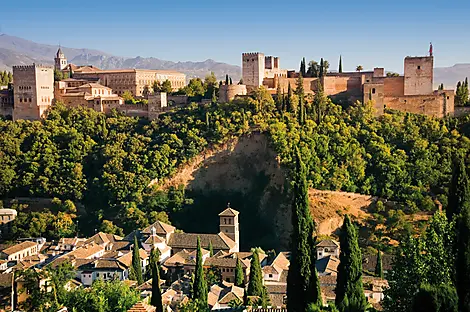
Day 5 - Malaga
A historical and festive town, Malaga is located in Andalusia, on the Costa del Sol. Between the marina and the beaches, the seaside promenade of La Farola offers an ideal setting for strolling and relaxing. Set slightly further back, the Malagueta bullring is one of the emblematic sites of the city. From the hill overlooking the old town, one can see Gibralfaro castle and the Alcazaba, two fortified ensembles rising out from the cypresses and maritime pines. To visit Pablo Picassoâs birthplace, you will go first to the courtly plaza de la Merced. A few streets back from here, you can explore the museum dedicated to the artist, in the Buenavista palace.
3 available excursions
Medieval Cordoba, Old Malaga & The Picasso Museum, Granada: The Moorish Legacy of Andalusia
Day 6 - Marbella
In the province of Malaga, Marbella is a renowned seaside resort on the Costa del Sol. The remains of early Christian and Roman sites around this former mining town, located at the foot of the Sierra Blanca mountains, bear witness to a rich history. With its white houses on flowery little streets, the old town is perfect for a pleasant stroll. The Plaza de los Naranjos, former focal point of the city, is near the 10th-century Arabic castle and the Church of Santa MarÃa de la Encarnación. Not far from here, youâll be able to discover the magnificent viewpoints offered by Ronda, a picturesque town perched 700 metres (2,296 feet) high. Its Puente Nuevo bridge majestically crosses the gorges of the Guadalevin River that cuts the town in two.
2 available excursions
In the Heart of Costa del Sol, Ronda and the Traditions of Bullfighting
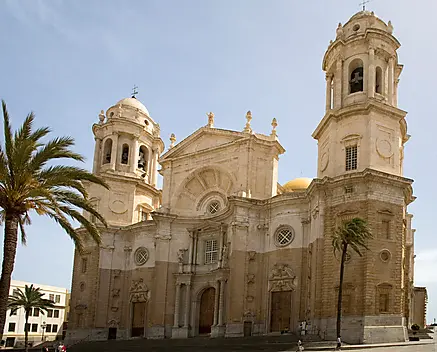
Day 7- Cadiz
Andalusiaâs Cadiz is located on the Costa de la Luz, in the south-west of Spain. From the beaches of Cortadura, to the flamenco bars of Santa Maria, through the colourful streets of la Viña, you will be amazed by this city, which is both steeped in history and extremely festive. In the medieval El Pópulo district, you will stroll along covered passages in the narrow gaps between houses. You will also be able to mosey around the lush Mina square. The star of the show is the magnificent cathedral and its dome crowned with yellow porcelain, presiding above the Ocean.
2 available excursions
Cadiz: Gateway to Southern Spain, Andalusian Treasures: Seville & Cathedral
Day 8 - Lagos
There stands a natural paradise called Lagos, bordered by the Atlantic Ocean, in the Algarve region of southern Portugal. With its picturesque and age-old town centre, and the Ponta da Piedade natural site sheltering paradisiacal beaches protected by captivating limestone cliffs in hues of ochre, Lagos enthrals, fascinates and enchants. In this interesting blend between nature and culture, do not miss the chance to stroll along the small paved streets of its historic centre, surrounded by impressive Moorish ramparts and edged with traditional white houses, with decorations sculpted in the stone. In particular, you will be able to admire the Manuelian-style Governor's Castle, the 17th-century Ponta da Bandeira Fort or the Church of Santo António in Baroque architecture.
5 available excursions
Silves and Monchique, Historical Alvor and Portimao, Seco & Benagil, The Sagres Peninsula, Lagos Walking Tour
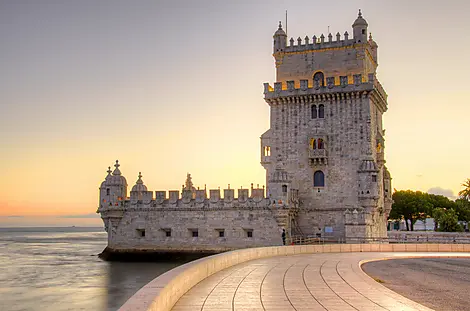
Day 9 - Lisbon
Portugalâs capital city located on the banks of the Tagus, only a few kilometres from the Atlantic coast, is a city of exceptionally rich cultural diversity. At the mouth of the river harbour, impose two UNESCO World Heritage monuments, Jeronimos monastery and Belem tower. The Alfama hillside is also worth visiting: known for its fado bars and its Moorish streets, this district is the oldest one of the city and one of the most typical. Not far from there, Chiadoâs elegant streets are home to big fashion labels and are an invitation to a bit of of luxury shopping.
Antarctic Peninsula: An Explorer's Expedition
Cruise Line: Polar Latitudes Expeditions
Ship: Ocean Victory | Ocean Albatros
Travel Period: Nov 21 2026 - Feb 21 2028
Port: Ushuaia to Ushuaia
Duration: 11 Days
Antarctic Peninsula: An Explorer's Expedition
Day 1
Arrive and explore in Ushuaia
After a friendly welcome at the airport and a transfer to the luxurious Arakur Ushuaia Resort & Spa, take some time to unwind or explore the southernmost city in the world, Ushuaia. (In the unlikely event that you can't be accommodated at the Arakur, you'll unwind at another of Ushuaia's top luxury hotels.)
Our optional evening briefing is your opportunity to ask questions and meet some of your fellow explorers.
Day 2
All Aboard!
Spend your morning relaxing at the hotel, visiting a museum, or exploring the shops in Ushuaia, before our mid-afternoon escort to the ship. Our Expedition Team and ship staff will welcome you on board and get you settled in, followed by a safety and orientation briefing and our Captainâs welcome dinner. Weâre on our way to Antarctica!
Day 3-4
Drake Passage
Join our Polar Experts as they share their vast knowledge of Antarctica, from its enchanting wildlife to its bold history. Participate in our pioneering Citizen Science program or sit back and take in this fabled journey while catching glimpses of rarely seen wildlife. Keep your binoculars handy to identify the many seabirds that escort our ship as we cross the Antarctic Convergence into Antarcticaâs waters and noticeably cooler temperatures.
Day 5
 South Shetland Islands
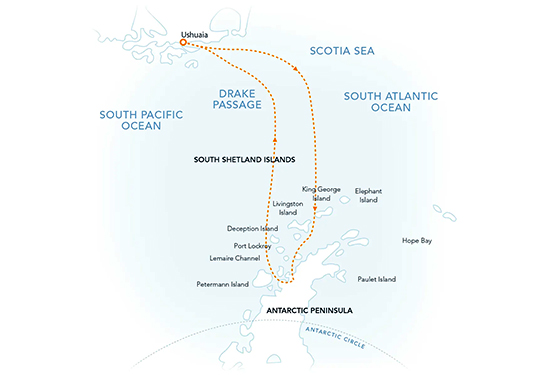
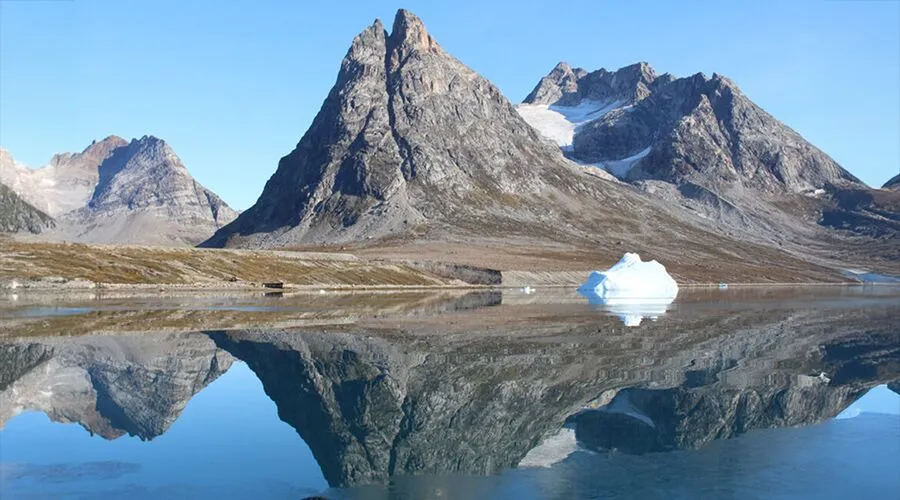
Over time, the volcanic activity of the South Shetland Islands has created a geology unlike any other. Here, you can expect a spectacular display of mountains, glaciers, and wildlife, including Chinstrap and Gentoo penguins, and itâs not uncommon to share the waterâs edge with Elephant and Fur seals. Whales are often spotted as well. So, weâll settle into our Zodiacs and spend most of our day exploring. And kayakers, itâs time to get your first taste of gliding just inches off the pristine Antarctic water. Whether on land or sea, in Zodiac or kayak, be prepared for a fully immersive introduction to this incomparable part of the world.
Day 6-8
Glorious Antarctica
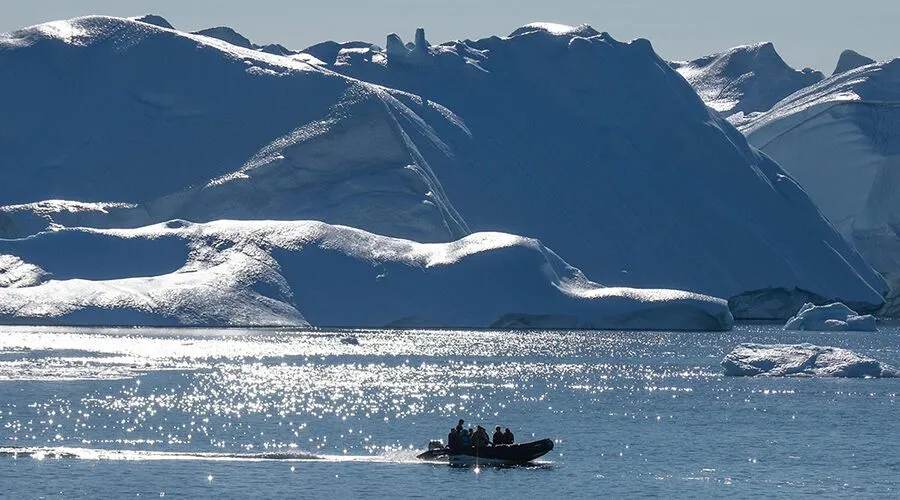
Hereâs our chance to explore any number of picturesque bays and landing sites, while maneuvering through iceberg-rich channels and into wildlife-rich waters. Weâll likely be joined by numerous species of enchanting penguins, seals, and whales, both in the sea and along the rugged coastlines. And there will be great opportunities to stop at several active scientific bases and historic landing sites during our typical two-a-day outings. A night of camping under the stars is also an unforgettable highlight for those who sign up. Our focus is always on the longest and most adventurous off-ship experience, so be prepared to take in all that Antarctica has to offer.
Day 9-10
Drake Passage
We leave this magical place and make our way north, once again heading across the Antarctic Convergence and the Drake Passage. We have one last hurrah as we celebrate the conclusion of our expedition with a special slideshow and a final meal together.
Day 11
Ushuaia Disembarkation
With huge smiles on weary, content faces, we disembark in the morning, letting you catch a flight to Buenos Aires or stay in Ushuaia for more sights and adventure.
Scottish Isles and Norwegian Fjords Voyage - with Smithsonian Journeys
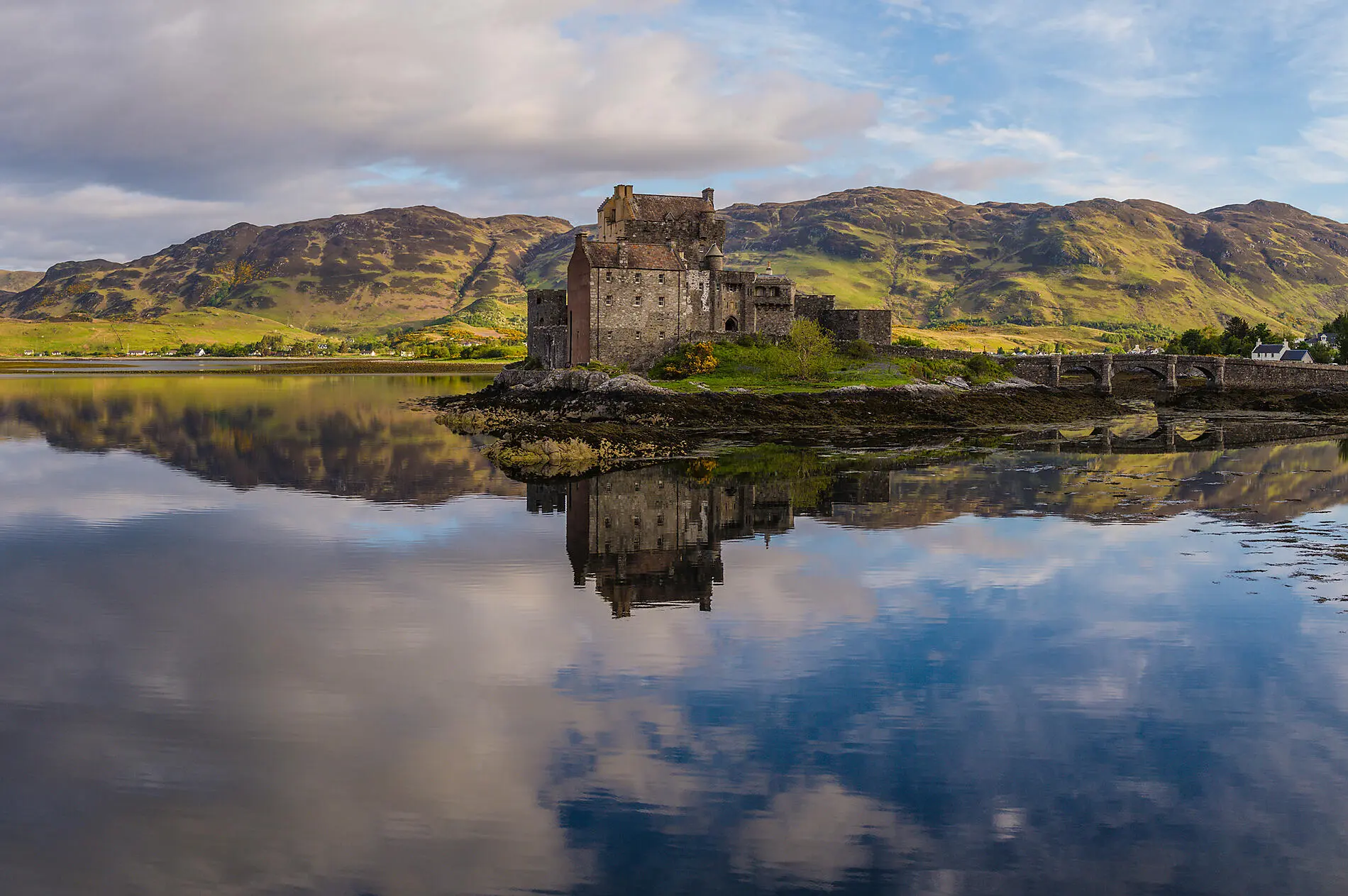
Cruise Line: Ponant Cruise
Ship: Le-Champlain
Travel Period: Aug 27 2027 - Aug 26 2028
Port: Bergen (Norway) to Glasgow, Scotland
Duration: 8 Days
toGlasgow,Scotland.webp "Scottish Isles and Norwegian Fjords Voyage - with Smithsonian Journeys")
Scottish Isles and Norwegian Fjords Voyage - with Smithsonian Journeys
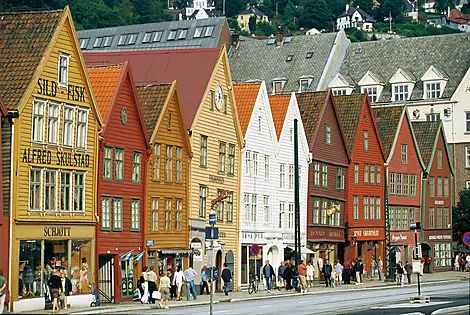
Day 1 - Bergen
Located at the end of Byfjord, Bergen was the capital of Norway in the 12th and 13th Centuries and has preserved some very beautiful monuments from the time when it was home to royalty. Wandering through Bergenâs streets means going back in time, in search of the hidden treasures that have been listed as World Heritage Sites by UNESCO. A veritable openair museum, Bergen is home to a thriving artistic community of painters, potters, jewellers. The Bergen cable car offers you a splendid panorama over the port and the surrounding fjords. Do not miss the visit to the old quarter with its narrow streets, a testimony of the power of the hanseatic League that controlled trade in Northern Europe at the end of the Middle Ages.
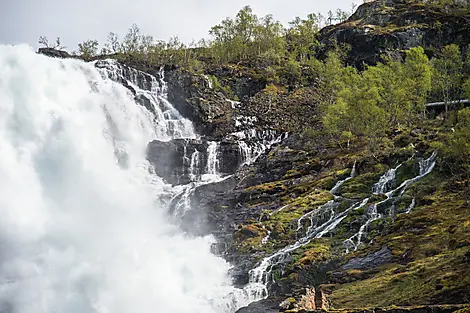
Day 2 - Flam
Nestled in the heart of the fjord country, less than 200 kilometres from Bergen, the picturesque village of FlÃ¥m â pronounced Flôm â offers you an experience of authentic Norway. You can mosey around the brightly coloured streets and admire the majestic contours of the surrounding mountains. The town is also the departure point for the mythical train route Flamsbana, 20 kilometres long, whose journey offers a superb view of the scenery, as sublime as it is pristine. This attraction makes FlÃ¥m one of the countryâs main tourist destinations.
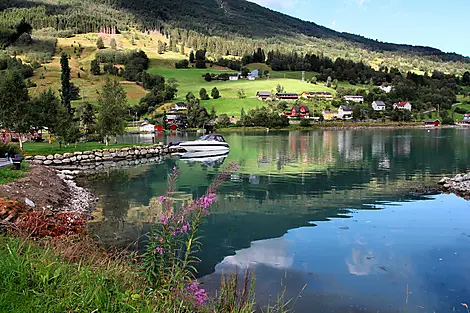
Day 3 - Olden
With its two wooden churches, one red and the other white, plus its breathtaking view of the mouth of the river Oldeelva, Olden looks just like a picture post card. Located a few kilometres from the Jostedalsbreen park, home to one of the last glacier polar icecaps, this little village is a definite must for exploring the blue languages of the Briksdal or Kjennalen glaciers. Make sure you find some time to visit the Norwegian Glacier Museum. Absolutely amazing. Another gem is lake Lovatn and its turquoise waters inviting you to quiet contemplation.
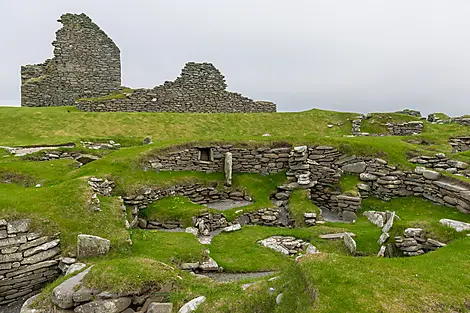
Day 4 - Lerwick, Shetland Islands
The small and charming capital of the Shetland Islands, with its sea front of old houses and narrow streets, offering travellers its old districts and a warm port atmosphere. Geopark Shetland, a UNESCO World Heritage Site, is located to the north. Incredibly well-preserved archaeological sites and ruins prove that the islandsâ occupation dates back to the first Neolithic colonies. The Shetland Museum and Archives recounts the Shetlandsâ history of heritage and culture: Lerwickâs abundant waters were even fished by the Dutch in the past.
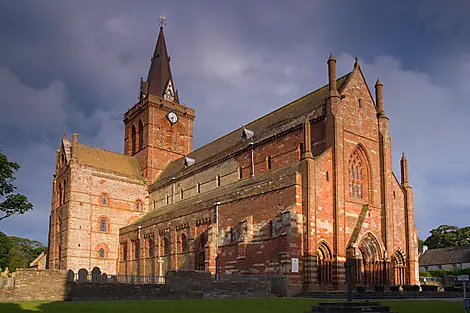
Day 5 - Kirkwall, Orkney
Capital of the Orkney archipelago, Kirkwall, which means âchurch bayâ, is an ideal stopover before continuing on to the Northern Isles. Sheltered in a wide bay, the lively town welcomes the visitor with its charming paved alleyways edged by old houses and craft shops. Tankerness House, the oldest homestead in the town, is a must-see landmark. But the true architectural treasure of the aptly named Kirkwall is none other than its remarkable red and gold stone cathedral. And because whisky is inseparable from Scotlandâs identity, stop at the Highland Park Distillery for a highly instructive visit.
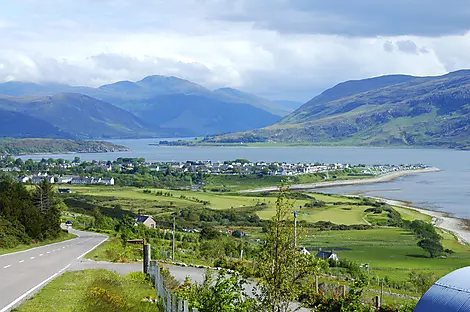
Day 6- Portree, Isle of Skye
Nestling in the crux of a gorgeous bay, Portree reflects the magnificence of the grandiose Isle of Skye as well as being its main town. Apart from the charm of its colourful houses, the townâs outstanding location on the banks of a loch makes it a very pleasant place to be. From its colourful harbour bustling with local craftsmenâs shops, you can take in a stunning view of the surrounding hills. Before trekking through the wilderness and drinking in the natural beauty of the Isle of Skye, check out some of the beautiful images in the Aros Centre.
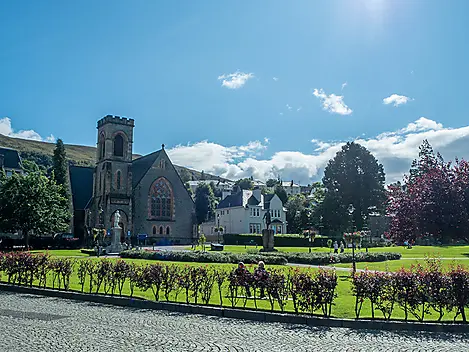
Day 7 - Fort William
A port town on the eastern shore of Loch Linnhe, Fort William is sometimes described as the "Outdoor Capital of the UK." Because it sits at the base of Ben Nevis, the highest peak in the British Isles, and is in close proximity to the dramatic landscape of Glencoe, it is a popular destination for hikers and rock climbers. For those looking for a less adventurous experience, the nearby Ben Nevis Distillery offers tours and tastings, and Old Fort and Old Inverlochy Castle are interesting historical sites.
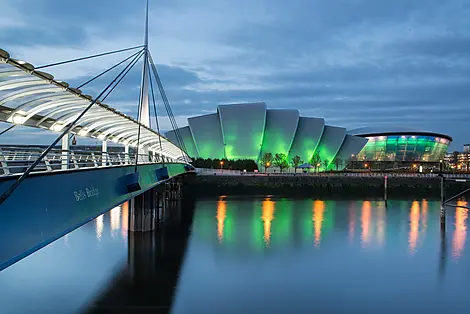
Day 8 - Glasgow, Scotland
In the heart of the Clyde Valley, the bustling city of Glasgow contrasts starkly with the wild beauty of the surrounding countryside. Scotland's biggest city overflows with landmarks from its extensive artistic heritage and outstanding architectural tradition. The city's chequerboard layout makes walking through the major pedestrian thoroughfares easy: go with the flow and let the lively street atmosphere take you past the many Victorian monuments. Don't miss the collections on display in the numerous museums and art galleries. The Kelvingrove Art Gallery and Museum is an outstanding example.
European autumn in the Aegean Sea
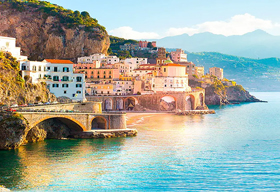
Cruise Line: Ponant Cruise
Ship: Le-Laperouse | Le-Bougainville | Le-Champlain
Travel Period: Nov 01 2026
Port: Athens to Athens
Duration: 8 Days
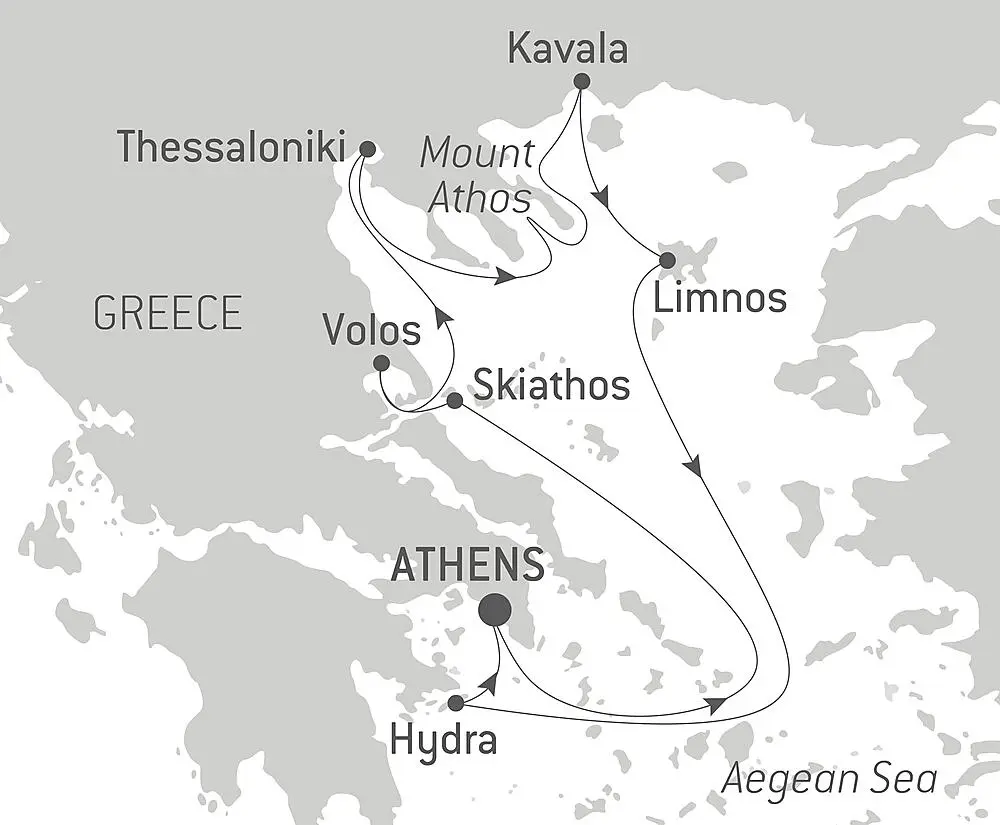
European autumn in the Aegean Sea
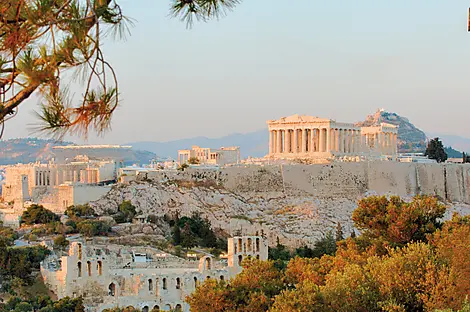
Day 1 - Athens
The Greek capital city is located on the edge of the Saronic gulf, in the east of the country. It bears a plural name in reference to the first villages that surround the Acropolis. You will be enchanted by the rocky plateau presided by its monuments listed as UNESCO World Heritage. In the city below, you can visit some of the liveliest districts in Athens: Plaka, with its maze of colourful streets, and where, in the evenings the drifting aroma of moussaka and garlic prawns will tickle your taste buds. The National Archaeological museum and the Cycladic Art Museum are also some of the cityâs key attractions and allow visitors to discover Athensâ cultural past.
Day 2 - Skiathos
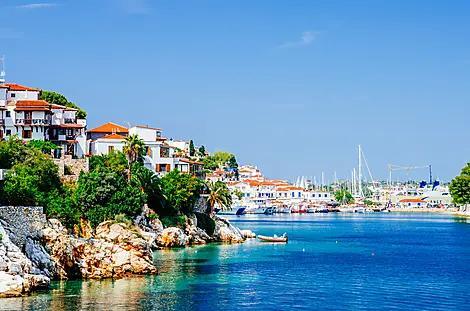
The small island of Skiathos is one of the treasures of the Aegean Sea, particularly appreciated for its magnificent beaches with turquoise waters, and also famous as one of the sites where the film Mamma Mia! was shot You will immediately fall under the charm of the main town, Skiathos, with its white houses, narrow streets and typical restaurants. You will have the possibility of discovering the former house of the famous novelist and poet Alexandros Papadiamantis, now a museum, as well as the Monastery of the Annunciation, commonly known as the Evangelistria Monastery, a post-Byzantine jewel with magnificent wall paintings. The many hiking trails will take you from coves to shady forests in an idyllic Mediterranean setting.
2 available excursions
Walking tour of Skiathos town, Hike on Skiathos Island
Day 3 - Volos
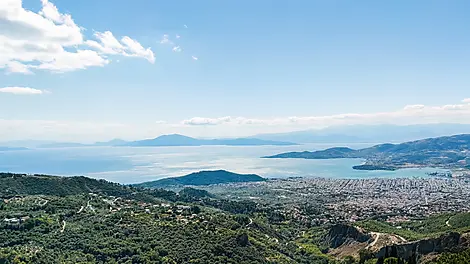
Volos, one of the biggest port cities in Greece, is located at the foot of Mount Pelion. According to mythology, Mount Pelion was a place of celebration for gods and heroes, and the home of the centaurs. The beauty of the place and the magical atmosphere that reigns here can indeed only have been inspired by the gods: the clear water that flows from a multitude of sources bathes the plane trees, apple trees, oaks, beech trees, gardenias, camellias, and hydrangeas that thrive in the fertile soil of Thessaly. Do not miss your chance to visit picturesque village of Milies in the hills, and to discover its traditional architecture.Â
2 available excursions
Spectacular Meteora monasteries, Theofilos Museum and Makrinitsa village
Day 4 - Thessaloniki
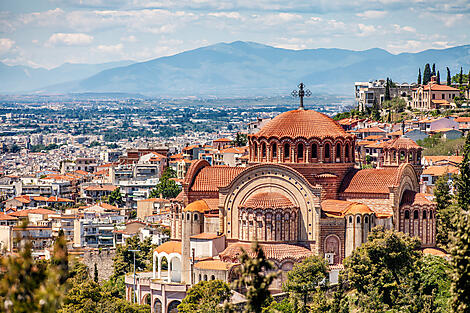
3 available excursions
The Royal Tombs of Vergina, Lecce, a journey back in time, Walking tour of Thessaloniki
Day 5 - Sailing along Mount Athos
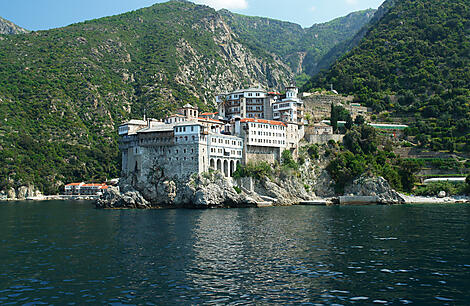
Mount Athos, a peninsula measuring 50 km (31 miles) long and 12 km (7 miles) wide and which rises to an altitude of 2,030 metres (6,660 feet), is also called âHoly Mountainâ because of the twenty or so orthodox monasteries and the 2,000 monks that it shelters. It was added to the UNESCO World Heritage list in 1988 thanks to its long religious history, the well-maintained agrarian architecture of the monasteries and the preservation of the flora and fauna around the mountain. Sailing around the peninsula, you will admire the majestic monasteries clinging to the rock face and overlooking the Aegean Sea.
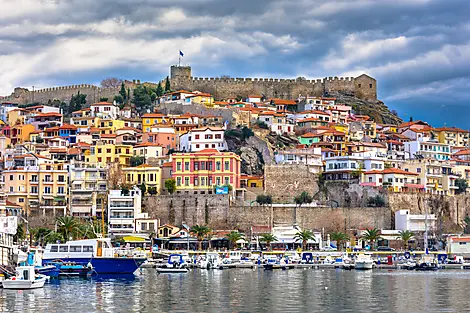
Day 6 - Kavala
Lying in north-east Greece, between East and West, Kavala has many treasures to offer, starting with a majestic fortress overlooking the Aegean Sea, while historical and architectural wonders lie hidden everywhere in the old town. You will have a chance to explore the archaeological site of Philippi, a fortified city founded in the 4th century BC, now a UNESCO World Heritage Site A real journey back in time, where Greeks, Romans and early Christians have all left visible marks. Known as the "Blue City", Chania is also one of Macedonia's most important ports, with delicious seafood restaurants all along its marina.
2 available excursions
Explore Kavala on foot, Archaeological Site of Philippi
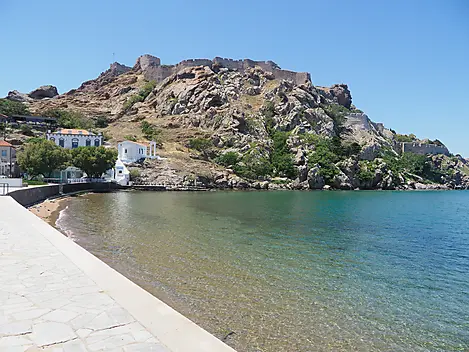
Day 7- Limnos Island
A volcanic island located near the Dardanelles Strait, Limnos was venerated during Antiquity. Legend has it that Hephaestus, the god of fire, had his forge here. Now one of Greeceâs major seaside resorts, Lemnos offers its visitors many superb sandy beaches. It is also home to several archaeological sites, such as the towers of Kastro, an ancient acropolis fortified by the Venetians, or the neolithic site of Poliochni and the city of Hephaestia. Renowned for its olives, fruits, wheat and honey, and for the authenticity of its inhabitants, Lemnos is also known for the quality of its restaurants, ideal for tasting typical Greek dishes.
2 available excursions
Myrinaâs castle and prehistoric site, Poliochni archaeological site & winery
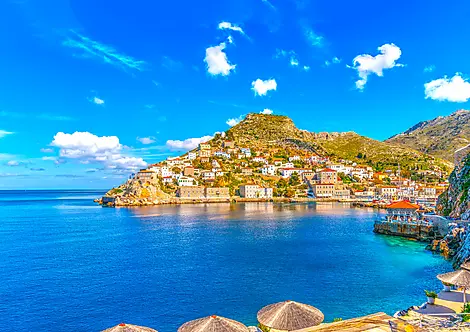
Day 8 - Hydra
This unusual gem belonging to the Saronic islands is located to the east of the Peloponnese. There are no cars here. Named after the island, the harbour town is layered up the slopes of a mountainous bay. You may be surprised to see beautiful stone mansions. These are traditional here, as are the multi-coloured caïques along the quays. Further along the shore, you will discover the Historical Archives Museum. Collections from Athens National History Museum are exhibited in the elegant villa Koundouriotis.
1 available excursions
A dive into Hydraâs history
Day 9 - Athens
The Greek capital city is located on the edge of the Saronic gulf, in the east of the country. It bears a plural name in reference to the first villages that surround the Acropolis. You will be enchanted by the rocky plateau presided by its monuments listed as UNESCO World Heritage. In the city below, you can visit some of the liveliest districts in Athens: Plaka, with its maze of colourful streets, and where, in the evenings the drifting aroma of moussaka and garlic prawns will tickle your taste buds. The National Archaeological museum and the Cycladic Art Museum are also some of the cityâs key attractions and allow visitors to discover Athensâ cultural past.
Panama, Colombia & Caribbean Islands
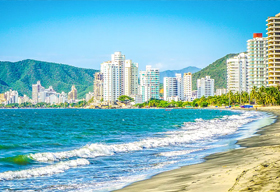
Cruise Line: Ponant Cruise
Ship: Le-Bellot | Le-Laperouse
Travel Period: Mar 12 2027 - Apr 08 2027
Port: Colon - Fort-de-France
Duration: 11 Days
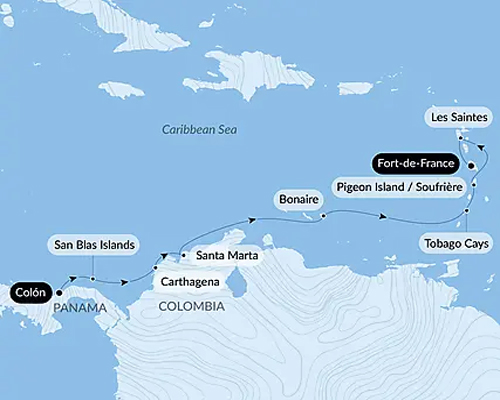
Panama, Colombia & Caribbean Islands
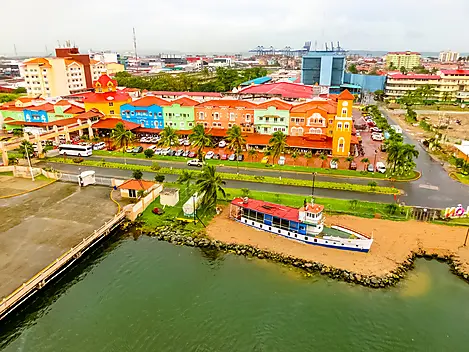
Day 1 - Colon
Colón is the second largest city in Panama, at the Caribbean entrance of the Panama Canal. Colón is today an important port, and the free trade zone created in 1953 contributed greatly to the development of the city. Colón was founded in 1850 by Americans working on the Panama railroad connecting the Atlantic and Pacific coasts through the isthmus of Panama; the city rapidly overshadowed the older Caribbean ports of Panama when the canal opened.
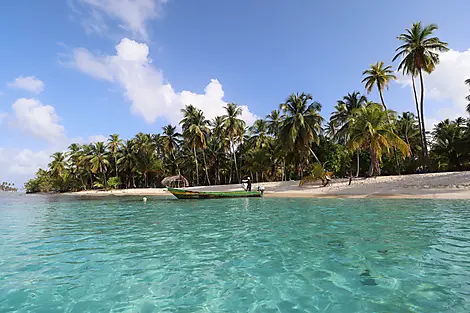
Day 2 - San Blas Islands
Located on the north-east coast of Panama, the San Blas archipelago is a string of coral islands in the heart of the Caribbean Sea. More than 300 islands and cays cover an area of 300 square kilometres offering travellers a multitude of treasures. Sheltered behind a long coral reef, the San Blas Islands are full of enchanting anchorages. The long sandy white beaches bound by crystal-clear waters will allow you to relax and enjoy incredible marine fauna before engaging with the Kunas Indian community. Still subsisting on hunting and fishing, they will welcome you in their villages of bamboo houses gathered near the beaches.
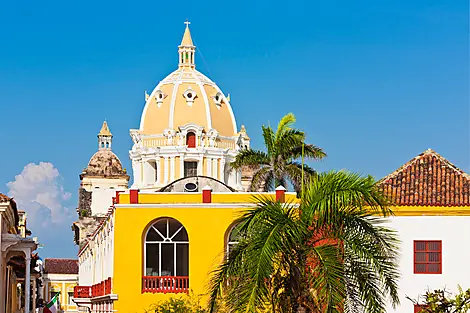
Day 3- Cartagena
A splendid harbour city in the north of Columbia, a source of inspiration for the Columbian writer Gabriel GarcÃa Márquez, Cartagena will win you over with its well-preserved colonial architecture, and warm friendly atmosphere. You can visit the sumptuous UNESCO World Heritage fortified historical centre whose churches and houses have magnificent multi-coloured façades. A witness of Spanish domination, the San Felipe de Barajas fortress stands on top of a hill from where you can admire views over the whole city. The Las Bóvedas neighbourhood will charm you with its arcades, used as prison cells during the 19th century civil wars.
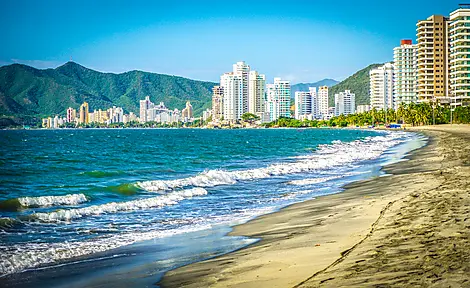
Day 4 - Santa Marta
Santa Marta, located in the north of the Caribbean coast of Colombia, is a seaside town dominated by the majestic Sierra Nevada. The highest coastal chain of mountains in the world, it is listed as a Biosphere Reserve by UNESCO for the diversity of its fauna and flora. At the heart of the first Spanish colony, you will discover the heritage of the Tairona, the largest indigenous civilisation in Colombia. The eponymous national park offers you sumptuous landscapes, combining lush tropical forest and beautiful fine sandy beaches edged with crystal-clear water. The archaeological heritage and the Pre-Columbian treasures of the region are a source of endless enchantment.
Day 5 - At sea
During your journey at sea, make the most of the many services and activities on board. Treat yourself to a moment of relaxation in the spa or stay in shape in the fitness centre. Depending on the season, let yourself be tempted by the swimming pool or a spot of sunbathing. This journey without a port of call will also be an opportunity to enjoy the conferences or shows proposed on board, depending on the activities offered, or to do some shopping in the boutique or to meet the PONANT photographers in their dedicated space. As for lovers of the open sea, they will be able to visit the shipâs upper deck to admire the spectacle of the waves and perhaps be lucky enough to observe marine species. A truly enchanted interlude, combining comfort, rest and entertainment.
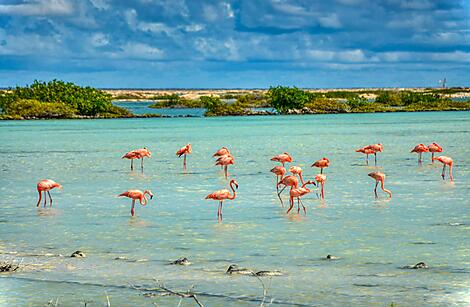
Day 6 - Bonaire
Surrounded by a barrier reef and a marine sanctuary, Bonaire is a true paradise for divers. This peaceful and preserved little island is renowned all over the world for its coral reefs, which are directly accessible from the beach, providing a unique sensation of freedom. Discover magnificent marine fauna and flora while snorkelling or diving in its turquoise waters. The Washington Slagbaai National Park in the north of the island is home to many birds. It is the most important breeding site in the south Caribbean for the pink flamingo, the islandâs emblematic animal.
Day 7 - At sea
During your journey at sea, make the most of the many services and activities on board. Treat yourself to a moment of relaxation in the spa or stay in shape in the fitness centre. Depending on the season, let yourself be tempted by the swimming pool or a spot of sunbathing. This journey without a port of call will also be an opportunity to enjoy the conferences or shows proposed on board, depending on the activities offered, or to do some shopping in the boutique or to meet the PONANT photographers in their dedicated space. As for lovers of the open sea, they will be able to visit the shipâs upper deck to admire the spectacle of the waves and perhaps be lucky enough to observe marine species. A truly enchanted interlude, combining comfort, rest and entertainment.
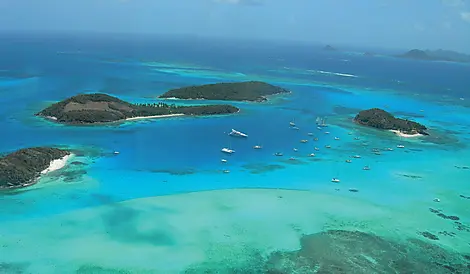
Day 8 - Tobago Cays
Scattered between St Vincent and Grenada, the Tobago Cays comprises five little islands: Petit Rameau, Petit Bateau, Baradal, Petit Tabac and Jamesby. This rosary of uninhabited cays in the southern West Indies is a marine park whose turquoise lagoons provide a home and safe haven for some outstanding marine fauna, including peaceful green turtles. Girded and united by a coral reef, these secluded islands are a peaceful paradise for divers, swimmers and snorkellers.
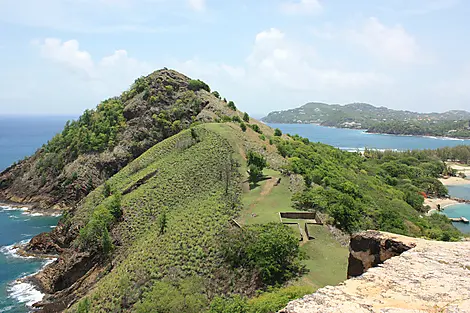
Day 9 - Pigeon Island Beach
Linked to St Lucia by a sand causeway, Pigeon Island has been a designated National Park since 1979. On this wild and pristine land, you will be inspired to take pleasant walks amid the tropical vegetation and through a magnificent tree-filled garden. You will also be irresistibly drawn to the two pretty little sandy beaches nestling on the southern side and bathed by crystal-clear waters. While snorkelling, be sure to explore the underwater world that is teeming with life, along the rocks lining this peninsulaâs coast. You will thoroughly enjoy the calm and beauty of this place, which is really conducive to simply relaxing.
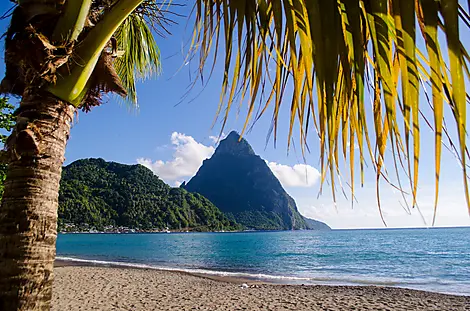
Day 10 - Soufriere
Nestled in the crook of a breath-taking bay, the former capital of St Lucia is brimming with attractions. Soufrière is famous for The Pitons, volcanic spires that tower over the entrance to the town. In the vicinity of the lush botanical gardens, you will be able to enjoy the curative powers of the Diamond Falls mineral baths. From the beach at the north end of the bay, you can set off to explore the reefs that are home to stunning gardens of sea fans at the foot of the cliffs that plunge into the sea.
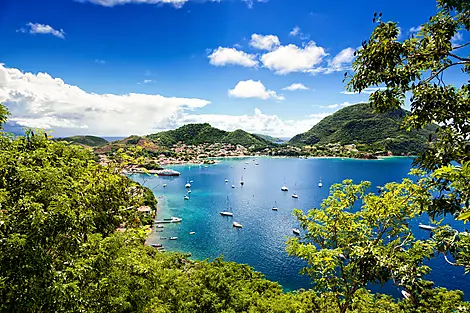
Day 11 - Les Saintes
During the feast of All Saints in 1493, Christopher Columbus discovered this archipelago of nine islands that he named "The Saints". Today, only two of them are inhabited. Terre de Haut, in the east, is dominated by the Morne Mire hill; at the summit stands Fort Napoleon, paying homage to the islands' history. In the heart of the botanical garden, shared by iguanas and cacti, there is an exceptional view of the Baie des Saintes, one of the most beautiful in the world. The long shady beach of Pompierre, where it is forbidden to drop anchor, is a peaceful place for a swim, while Pain de Sucre Beach offers wonderful opportunities for snorkelling. On the island, donât forget to taste the local speciality, the âtourment dâamourâ, a cake made with coconut.
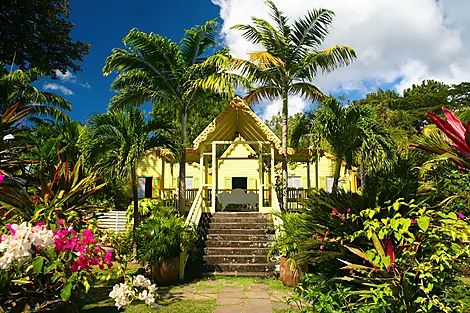
Day 11 - Fort-de-France
Located on the western coast of Martinique, Fort-de-France will amaze you by the splendour of its bay, a magnificent cut-out in the coastline, considered as one of the most beautiful in the world. At the harbour mouth, on its strip of land, fort Saint-Louis overlooks the capital city of Martinique. If you climb up to it, you can see some breath-taking views. Saint Louis Cathedral and the Schoelcher library bear witness to a secular history, intimately linked to the islandâs story. Why not try some fresh coconut at the colourful Grand Marché. Two really pleasant places you can take a breather in, right in the heart of the city, are the garden of Balata and the Aimé Cesaire park.
Emblematic South American shores and cities

Cruise Line: Ponant Cruise
Ship: L-Austral
Travel Period: Mar 16 2027 - Mar 18 2028
Port: Buenos Aires - Rio de Janeiro
Duration: 11 Days
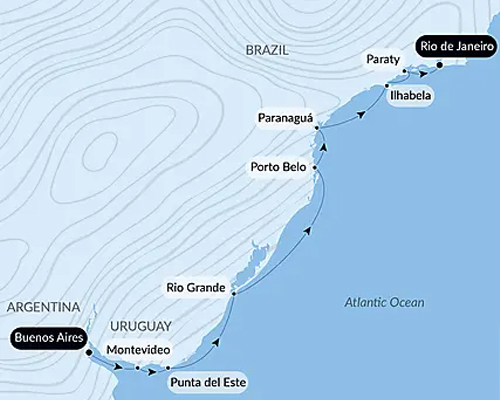
Emblematic South American shores and cities
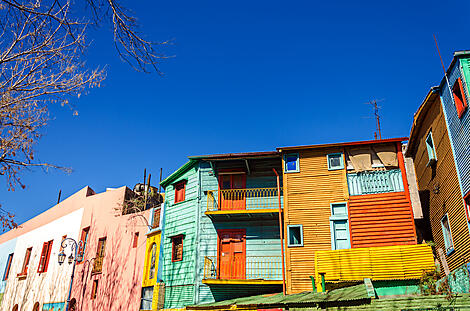
Day 1 - Buenos Aires
A port city built on the south-western shore of the Rio de la Plata, between the Atlantic Ocean and the vast Argentine Pampas, Buenos Aires is a unique city in Latin America. Nicknamed âthe Little Paris of South Americaâ, the Argentine capital is a clever blend of architecture with European influences and a joyful Latin American atmosphere. Designed on an orthogonal grid plan, it has 48 districts, all of which are as charming as they are different, with a range of styles such as Belle Ãpoque, gothic and baroque. With its markets overflowing with treasures, its legendary cultural and architectural heritage, and tango providing its background music, the Argentine capital will delight you on every street corner.
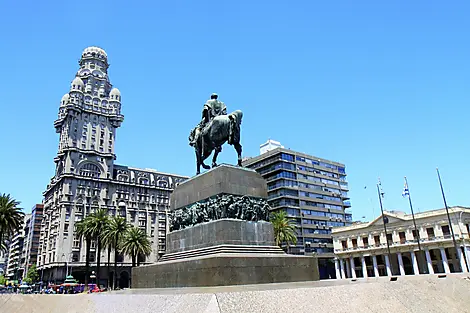
Day 2 - Montevideo
Perched on the far southern tip of Uruguay, Montevideo is a white city, and one of the loveliest capital cities of South America. Come and admire the beautiful historical remains dating from Spanish rule; youâll find the most interesting within the Cuidad Vieja, formerly fortified, its old town dates from the 18th century. The best preserved are the cathedral and the former governmental palace of the Cabildo, both listed historical monuments. In the crook of a vast blue bay, the city is also blessed with beautiful beaches.
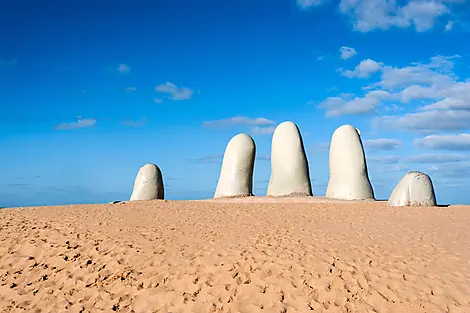
Day 3- Punta del Este
The jewel of south-eastern Uruguay, Punta del Este is a gentle blend of sky and sea. Its endless beaches, lapped by the Atlantic, invite contemplation and freedom. On Brava Beach, La Mano, a sculpted hand rising mysteriously from the sand, is a testament to eternity and the fragile bond between man and nature. Nicknamed the âSaint-Tropez of South Americaâ, the city combines urban elegance and wild beauty, offering a promise of wonder where every moment is imbued with timeless magic.
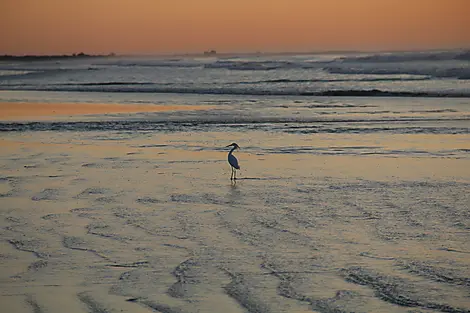
Day 4 - Rio Grande
Rio Grande is one of the oldest cities in the State of Rio Grande do Sul and bears the legacy of centuries past. Founded in the 18th century, this city with Portuguese roots reveals rich heritage: century-old churches, colonial façades and cobbled streets bearing witness to the maritime era. The State Capital from 1835 to 1845, it has been at the heart of significant events in Brazilian history. From the Brazilian city, you will travel to a typical farm, very close by, where you will be invited to meet the gauchos, guardians of herds of livestock, discover the local ancestral techniques for drying meat and taste the local products.Â
Day 5 - At sea
During your journey at sea, make the most of the many services and activities on board. Treat yourself to a moment of relaxation in the spa or stay in shape in the fitness centre. Depending on the season, let yourself be tempted by the swimming pool or a spot of sunbathing. This journey without a port of call will also be an opportunity to enjoy the conferences or shows proposed on board, depending on the activities offered, or to do some shopping in the boutique or to meet the PONANT photographers in their dedicated space. As for lovers of the open sea, they will be able to visit the shipâs upper deck to admire the spectacle of the waves and perhaps be lucky enough to observe marine species. A truly enchanted interlude, combining comfort, rest and entertainment.
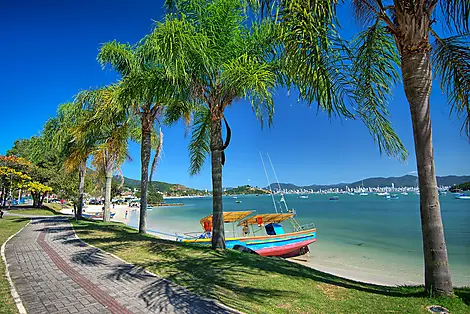
Day 6 - Porto Belo
Nestling in the heart of Brazilâs Emerald Coast, Porto Belo exemplifies timeless escape. Its golden beaches, lulled by the whisper of the waves, are an invitation to serenity, while its lush vegetation reveal a preserved natural setting. It is a place where natural beauty joins forces with the soul of Brazil. This former fishing village, colonised by the Azoreans in the 18th century, is also the gateway to destinations such as Florianópolis.
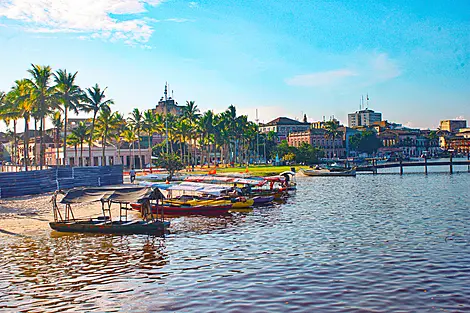
Day 7 - Paranagua
Paranaguá, founded in 1648, is a city where time seems to stand still, preserving the traces of a fascinating past. Its streets whisper the secrets of past centuries, and its shores remember the first travellers. The city shelters some of Paranáâs oldest remains, reminders of an epoch steeped in history. Let yourself be swept away by the soul of this port, where architecture from another age, traditions and memory interlace beneath the sea breeze. Stroll around and take in the magic of this place where past and present come together with timeless beauty.
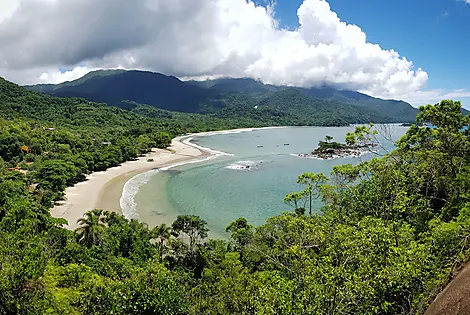
Day 8 - Ilhabela
A precious pearl on the Brazilian coast, in the State of São Paulo, Ilhabela, or the island of 365 waterfalls, according to legend, reveals itself between lush jungle and emerald water. Bathed by the soothing sound of the ocean, it is a little paradise for souls in search of serenity. Its immaculate beaches, edged with swaying coconut trees, stretch out beneath an infinite sky. In the heart of this island discovered by the Portuguese in 1502 lies a lush forest whispering promises of wonder. Crystal-clear waterfalls, mysterious paths and the symphony of the birds invite you to commune with nature. In 1977, the majority of the archipelagoâs surface area was declared a State Park and UNESCO Biosphere Reserve.
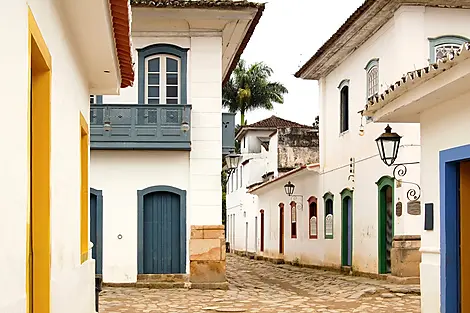
Day 9 - Paraty
To the South of Rio, you will discover the charming village of Paraty. Bathed in the emerald waters of the Ilha Grande Bay, surrounded by verdant hills and islets, it is one of the jewels of Brazilâs Costa Verde. Here, time seems to have stopped in the time of the conquistadors and their gold-laden galleons. You will love the splendour of Paratyâs heritage â its maze of paved streets, the historic beauty of its colonial houses, its baroque churches. Above all, you will be enchanted by its lively terraces where locals and visitors enjoy grilled fish accompanied by glasses of cachaça. It is, quite simply, a little taste of paradise on Earth!
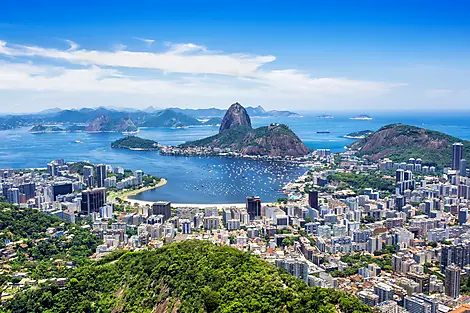
Day 10 - Rio de Janeiro
Famed for its colourful Carnival and now as host of the 2016 Summer Olympics, Brazilï¾s former capital is dubbed the ï¾City of Marvelsï¾ by locals. You canï¾t help being astounded by the panorama that opens up to you from the summit of Corcovado, the rocky peak where the giant statue of Christ the Redeemer has stood for nearly a century. In downtown Rio historic monuments such as the National Museum of Fine Arts sit side-by-side with modernistic buildings such as the cathedral of São Sebastião. On the seafront, Atlântica Avenue runs alongside Copacabana Beach; enjoy a birdï¾s eye view from the cable car ride to the top of Sugarloaf Mountain.
Iconic Capitals & Towns of the Baltic

Cruise Line: Ponant Cruise
Ship: Le-Champlain
Travel Period: May 21 2027
Port: Helsinki (Finland) to Copenhagen
Duration: 8 Days
toCopenhagen.webp "Iconic Capitals & Towns of the Baltic")
Iconic Capitals & Towns of the Baltic
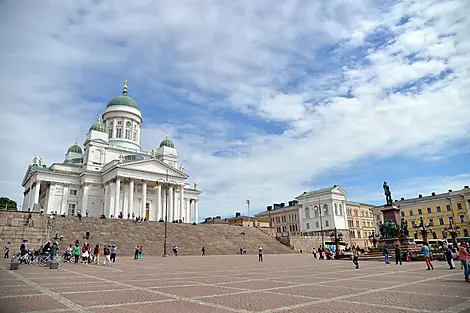
Day 1 - Helsinki
Seated in the southern peninsula of Finland, Helsinki offers the buzz of a cosmopolitan city that has opted for both elegance and beauty. Explore its historical centre where the soft hues of neoclassical buildings are juxtaposed with spectacular modern constructions. The bustling Kallio district is teeming with boutiques and restaurants where you can taste some local specialities like graavilohi - a sweet, marinated, aromatic salmon dish. Keskuspuisto park, a stoneâs throw from the centre, is a good place to sit and unwind.
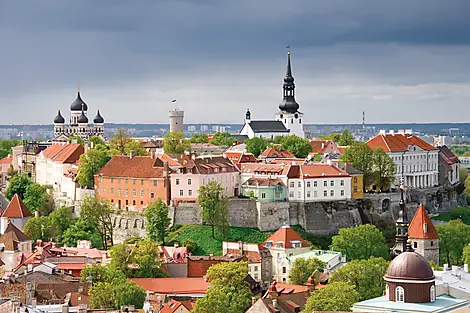
Day 2 - Tallinn
Opening onto the Baltic sea, to the far north of Estonia, the town of Tallinn will win you over with the picturesque charm of its architecture. You can meander through its little streets in the heart of the medieval centre where its gothic town hall has been standing since 1404. The Kiek in de Kök tower, the Orthodox Alexander Nevski cathedral, or Toompea castle give visitors a taste of this townâs rich past. The city was particularly active during the medieval period, as is demonstrated by the very beautiful monuments from this period that are still visible. Don't hesitate to lose yourself in the heart of Tallinn, listed as a UNESCO World Heritage Site.
1 available excursion
Tallinn & folklore
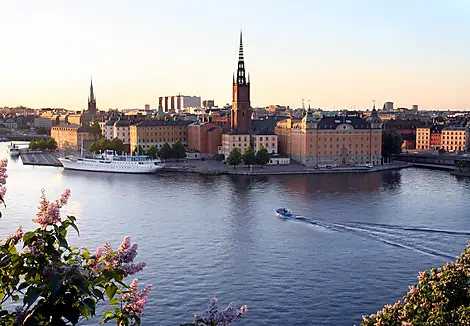
Day 3-4 - Stockholm
The capital of Sweden occupies an archipelago in the east of the country at the junction of Mälar Lake and the Baltic sea. In Gamla stan, meaning âold townâ in Swedish, you can stroll at your leisure in picturesque medieval streets until you reach the majestic Royal Palace. On the green island of DjurgÃ¥rden, you can visit several very different kinds of cultural centres: the Vasa museum is dedicated to a 17th century three-mast, the ecomuseum of Skansen presents traditional customs, and the ABBA museum is dedicated to the legendary pop group. For a fantastic, all-encompassing view of Stockholm, you can take a ride in SkyView, a glass-encased sphere gondola that takes you to the top of the worldâs largest building, the Ericsson Globe, a Stockholm landmark.
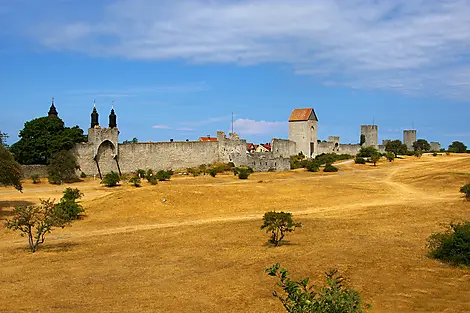
Day 5 - Visby, Gotland
This old Hanseatic city lies to the west coast of Gotland, a Swedish island in the Baltic sea. Pass through the spectacular Visby fortifications and visit the old town, a UNESCO World Heritage site. Youâll discover the grand Visby homes of rich merchants as well as the lovely low wooden houses in the little cobbled streets. Donât miss Saint Maryâs cathedral with its octagonal steeples, as well as Powder tower along the fortifications. Make sure you stop over in one of the rose-adorned cafés; indeed roses abound in this town where you can taste one of the islandâs specialities, namely saffron pancakes with red fruit.
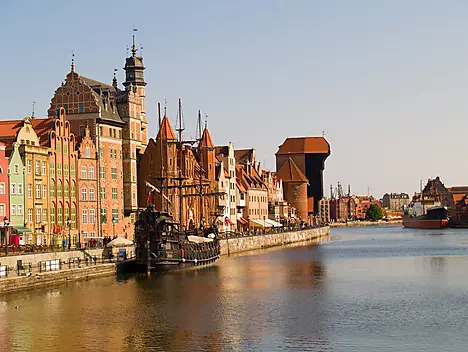
Day 6 - Gdansk
This ravishing city on the Baltic sea is nicknamed âthe golden door of Polandâ, and youâll understand why when you see its beautiful Hanseatic architecture. Youâll be charmed by the mouldings and gables that enhance the colourful façades of the houses. Along the Vistula Quays, you can take a pleasant stroll among the crafts shops. In elegant Mariacka street, the amber jewellers will most certainly tempt you into their boutiques. You can visit the church of Saint-Mary and its astronomic clock. Not far, the majestic Long Market square offers the famous Artus Court and the rich Gdansk History Museum.
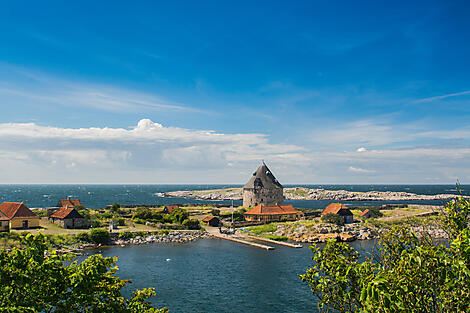
Day 7 - Christiansoe
In the very heart of the Baltic Sea, in the Ertholmene archipelago, the small island of Christiansoe â less than 0,5 km2 (barely 0,3 square miles) â awaits you. Thanks to its geographic form, which constitutes a natural harbour with the island of Frederiksø, it has been used as such for more than a thousand years. Pirates and fishermen succeeded one another here before the construction of its fortress, built between the 17th and 18th centuries, in the time of the Danish-Swedish wars. Visiting Christiansoe, you see the shaping of great history, the re-emergence of the rivalries and alliances that took place in the Baltic Sea. Today, this peaceful island offers you wild and preserved nature. A natural reserve since 1926, it is home in particular to a very large population of nesting and migrating birds that find food and tranquillity here.
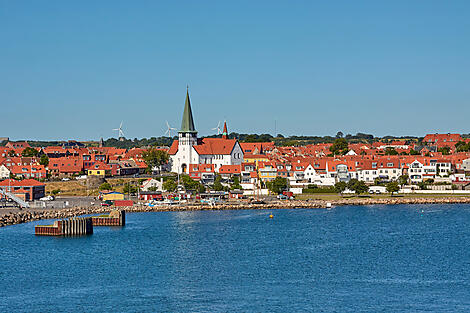
Day 7 - Ronne
To the south-west of the Baltic Sea, the small Danish island of Bornholm is a magnificent and light-filled setting for the charming town of Ronne, its capital. Close to Sweden, Poland and Germany and coveted many times for its strategic position, the island has managed to preserve its identity. Strolling its cobbled streets, fall under the spell of the colourful half-timbered houses and discover Denmarkâs oldest theatre. The museum located in a former market hall retraces the traditional life of the island and its history. In the midst of landscapes alternating rocky coastlines and fine sandy beaches, maybe you will come across the medieval fortress of Hammerhus, or one of the remarkable round churches scattered over the island.
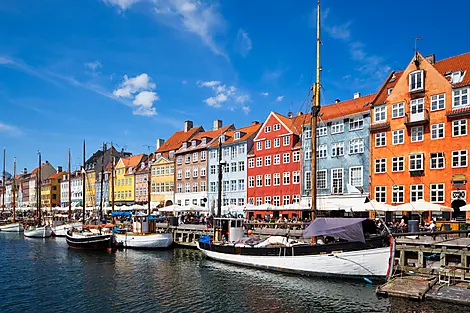
Day 8 - Copenhagen
Connected to the far eastern side of Sealand island, a few kilometres away from the Swedish coasts, Copenhagen offers you the high colour of Scandinavian capitals. You can discover the city's riches that weaves through the canal networks through the historical districts of Christiansborg and Nyhavn. Many palaces provide an apercu of Danish history. For eating, you can try out the smorrebrod, traditional danish sandwiches made with ham, cheese or smoked fish.
Scottish Isles and Norwegian Fjords Voyage - with Smithsonian Journeys
Cruise Line: Ponant Cruise
Ship: Le-Laperouse
Travel Period: May 24 2027 - May 19 2028
Port: Glasgow, Scotland (United Kingdom) to Bergen (Norway)
Duration: 8 Days
toGlasgow,Scotland.webp "Scottish Isles and Norwegian Fjords Voyage - with Smithsonian Journeys")
Scottish Isles and Norwegian Fjords Voyage - with Smithsonian Journeys
Day 1 - Glasgow, Scotland
In the heart of the Clyde Valley, the bustling city of Glasgow contrasts starkly with the wild beauty of the surrounding countryside. Scotland's biggest city overflows with landmarks from its extensive artistic heritage and outstanding architectural tradition. The city's chequerboard layout makes walking through the major pedestrian thoroughfares easy: go with the flow and let the lively street atmosphere take you past the many Victorian monuments. Don't miss the collections on display in the numerous museums and art galleries. The Kelvingrove Art Gallery and Museum is an outstanding example.
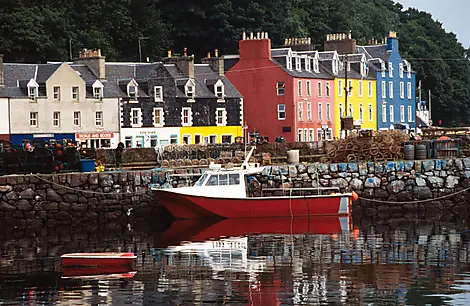
Day 2 - Tobermory, Isle of Mull
Located at the northernmost tip of the lovely Isle of Mull, Tobermory has to be one of the most beautiful natural seaports on Scotlandâs West Coast. Founded in 1788, this ancient fishing village has been converted to a leisure port highly appreciated today for its surroundings and the quiet charm it exudes. You will definitely be won over by the row of many-storied houses on the hillside, illuminating the harbour with their vibrant colours. Although the real spectacle is outdoors, no less interesting are the Mull Museum dedicated the local history and the exhibitions at the An Tobar art gallery.
3 available excursions
Duart Castle, Taste of Tobermory, Aros Park Coastal Walk
Day 3- Portree, Isle of Skye
Nestling in the crux of a gorgeous bay, Portree reflects the magnificence of the grandiose Isle of Skye as well as being its main town. Apart from the charm of its colourful houses, the townâs outstanding location on the banks of a loch makes it a very pleasant place to be. From its colourful harbour bustling with local craftsmenâs shops, you can take in a stunning view of the surrounding hills. Before trekking through the wilderness and drinking in the natural beauty of the Isle of Skye, check out some of the beautiful images in the Aros Centre.
3 available excursions
Eilean Donan Castle and Cuillin Mountains, Armadale Castle and Gardens, A Day on Skye
Day 4 - Kirkwall, Orkney
Capital of the Orkney archipelago, Kirkwall, which means âchurch bayâ, is an ideal stopover before continuing on to the Northern Isles. Sheltered in a wide bay, the lively town welcomes the visitor with its charming paved alleyways edged by old houses and craft shops. Tankerness House, the oldest homestead in the town, is a must-see landmark. But the true architectural treasure of the aptly named Kirkwall is none other than its remarkable red and gold stone cathedral. And because whisky is inseparable from Scotlandâs identity, stop at the Highland Park Distillery for a highly instructive visit.
2 available excursions
Orkney Treasures & St Magnus Cathedral, Orkney Past and Present
Day 5 - Lerwick, Shetland Islands
The small and charming capital of the Shetland Islands, with its sea front of old houses and narrow streets, offering travellers its old districts and a warm port atmosphere. Geopark Shetland, a UNESCO World Heritage Site, is located to the north. Incredibly well-preserved archaeological sites and ruins prove that the islandsâ occupation dates back to the first Neolithic colonies. The Shetland Museum and Archives recounts the Shetlandsâ history of heritage and culture: Lerwickâs abundant waters were even fished by the Dutch in the past.
3 available excursions
Hiking Mousa Island, Lerwick Walking Tour & Shetland Museum, Jarlshof and Sumburgh Head
Day 6 - Olden
With its two wooden churches, one red and the other white, plus its breathtaking view of the mouth of the river Oldeelva, Olden looks just like a picture post card. Located a few kilometres from the Jostedalsbreen park, home to one of the last glacier polar icecaps, this little village is a definite must for exploring the blue languages of the Briksdal or Kjennalen glaciers. Make sure you find some time to visit the Norwegian Glacier Museum. Absolutely amazing. Another gem is lake Lovatn and its turquoise waters inviting you to quiet contemplation.
2 available excursions
From Fjord to Sky by Cable Car, Briksdal Glacier with Troll Cars
Day 7 - Flam
Nestled in the heart of the fjord country, less than 200 kilometres from Bergen, the picturesque village of FlÃ¥m â pronounced Flôm â offers you an experience of authentic Norway. You can mosey around the brightly coloured streets and admire the majestic contours of the surrounding mountains. The town is also the departure point for the mythical train route Flamsbana, 20 kilometres long, whose journey offers a superb view of the scenery, as sublime as it is pristine. This attraction makes FlÃ¥m one of the countryâs main tourist destinations.
1 available excursions
The Flåm Railway
Day 8 - Bergen
Located at the end of Byfjord, Bergen was the capital of Norway in the 12th and 13th Centuries and has preserved some very beautiful monuments from the time when it was home to royalty. Wandering through Bergenâs streets means going back in time, in search of the hidden treasures that have been listed as World Heritage Sites by UNESCO. A veritable openair museum, Bergen is home to a thriving artistic community of painters, potters, jewellers. The Bergen cable car offers you a splendid panorama over the port and the surrounding fjords. Do not miss the visit to the old quarter with its narrow streets, a testimony of the power of the hanseatic League that controlled trade in Northern Europe at the end of the Middle Ages.
*Prices are per person in a shared DBL/TWN cabin. Prices do not include Government Fees & Taxes. Pricing and availability subject to change without notice. STIC Travel Group reserves the right to refuse or honor any prices / sailings that are erroneously printed or quoted. Terms & Conditions apply.

We Accept: 
Secured By: 
Copyright © STIC GSA Services Pvt. Ltd. All rights reserved